The wooden sculpture "Drinking Water Horn" from the heyday of medieval Sweden

The wooden sculpture "Drinking Water Horn" from the heyday of medieval Sweden

The name of the cultural relic is the drinking water horn, which is currently housed in the Swedish History Museum. A birch wooden drinking water horn from the medieval peak of 1250-1299, with two dragon and griffin shaped figures carved on it. The end of the horn is shaped like a dragon's head, turn the head towards the edge. The grappling bucket bites the edge with its beak, while the kite bites the wings of the grappling bucket, connecting the end to the edge. There are three copper strips around the horn and two simple mortise and tenon legs for support.
Anglo Saxon cremation urn

Anglo Saxon cremation urn

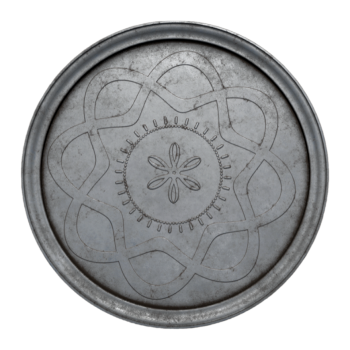
This cultural relic was unearthed on Mount Love in Lincolnshire, England. It is 155mm high and 180mm in diameter. There is a rune inscription (Si 동æ b æ d - a person's name) on this urn, which is one of the earliest Old English scripts. This cultural relic is currently housed in the British Museum.
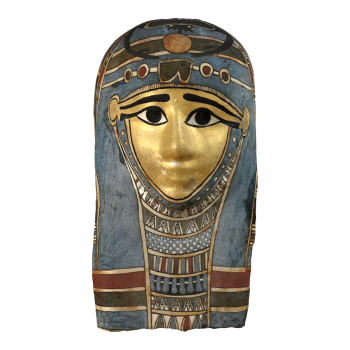
One of the coffins of Senechem in ancient Egypt

One of the coffins of Senechem in ancient Egypt

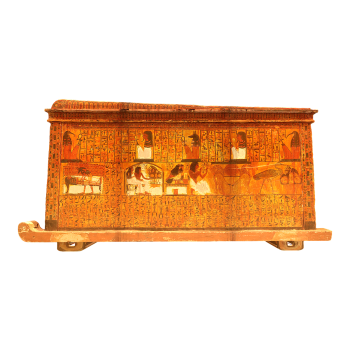
Senechem was a bricklayer who lived during the 19th Dynasty of ancient Egypt. In 1886, this coffin was discovered in the tomb of Deir al Medina in Egypt. It is housed in the Egyptian Museum.
Anubis Shrine in the Tomb of Ancient Egyptian Pharaoh Tutankhamun
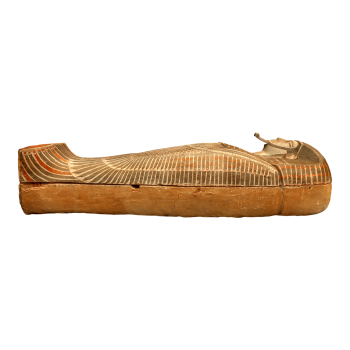
Anubis Shrine in the Tomb of Ancient Egyptian Pharaoh Tutankhamun

The artifact is a gilded wooden shrine with a reclining statue of Anubis placed on top. This shrine was found in the "treasury" room of the tomb of Egyptian pharaoh Tutankhamun. The treasury room is a place in Tutankhamun's tomb used to store treasures and treasures. The shrine consists of two parts, with an insertable Anubis statue at the top and an independent storage room with a sliding cover at the bottom. The sliding cover can be opened to expose the internal compartments. The front part of the compartment is divided into four smaller compartments. At present, this cultural relic is housed in the Egyptian Museum.
The wooden coffin of Pharaoh Kamosis in ancient Egypt
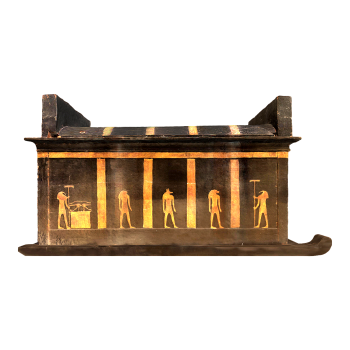
The wooden coffin of Pharaoh Kamosis in ancient Egypt

Kamosis was a pharaoh of the 17th Dynasty of ancient Egypt, who inherited the war initiated by his predecessor, Seqenenra Taa, to expel the kings of the Hyksos dynasty. The wooden coffin of Kamosis is currently on display at the Egyptian Museum in Cairo. This is one of the most important collections of ancient Egyptian art and artifacts in the world.
Wooden coffin of ancient Egyptian nobleman Yuya

Wooden coffin of ancient Egyptian nobleman Yuya

Yuya was a powerful aristocrat in the 18th Dynasty of ancient Egypt. This coffin is rectangular, with a flat top and protruding structures at both ends. The coffin is dark brown with golden inscriptions and illustrations on it. The coffin is evenly distributed with vertical golden stripes along its length. The coffin depicts the image of characters, possibly representing gods or important individuals, painted in traditional Egyptian art style with golden pigments. This coffin is currently at the Egyptian Museum.
The coffin of Pharaoh Amenhotep I of ancient Egypt

The coffin of Pharaoh Amenhotep I of ancient Egypt

This is the wooden coffin of Pharaoh Amenhotep I of the 18th Dynasty of ancient Egypt, currently housed in the Egyptian Museum in Cairo. In 1881, this coffin was discovered in the royal mummy vault of DB320 tomb. However, this is an alternative coffin originally made for a priest named Djehutymose. The inscription in front of the coffin calls on the god Osiris Winnever to provide Amenhotep I with bread, beer, cattle, poultry, and all good and pure things.
Bronze censer in the Western Han Dynasty

Bronze censer in the Western Han Dynasty

This artifact is an incense burner with geometric decoration and narrative scenes. It is made of bronze and inlaid with gold, silver, turquoise and onyx. The dimensions are 17.9cm high and 10cm wide. The artwork may have originated in Henan or Hebei province. The date of production is about the 2nd century BC and belongs to the early Western Han Dynasty. The work is now in the collections of the Freer Gallery and the Arthur M. Sackler Gallery.
South Korea crane cloud plum bottle

South Korea crane cloud plum bottle

This is a South Korea plum bottle decorated with cranes and clouds (a popular pattern on Korean celadon) made in the second half of the 12th century. South Korea plum bottle (Korean Meiping) is a traditional South Korea ceramic. It is a unique bottle, usually with a tall and thin cylindrical body, a slender neck and a closed mouth. The design of the plum bottle was influenced by the plum bottle of the Song Dynasty in China, but South Korea plum bottle has its own unique style and characteristics.
Korean Koryo period bronze basin "pilgrimage inscription bronze binaural basin"

Korean Koryo period bronze basin "pilgrimage inscription bronze binaural basin"

The charm of this relic lies in the fine decoration of its silver inlay: the five-character and four-line poem is intertwined with the image of the child. These poems, which evoke the concepts of no attachment and no duality, were written by Buddhist monks. One of the main decorative elements of this basin is that a child, probably a young Buddhist pilgrim named Sultanna, goes on a long spiritual journey in search of enlightenment. This bronze basin was made during the Koryo period (918-1392) between 1100 and 1200 AD. The basin was sold by London Gallery Limited to the Cleveland Museum of Art.
The coffin of Akhenaten in Tomb KV55, Valley of Egypt

The coffin of Akhenaten in Tomb KV55, Valley of Egypt

Akhenaten, also known as Inu or Amenlu Ahtnu, was an 18th dynasty pharaoh of ancient Egypt, reigning from about 1353 BC to about 1336 BC. He was the son of Egyptian pharaoh Amenlu Ahtep III (Amenhotep III) and Queen Tiye, father of Tutankhamun. In 1907, the tomb was discovered. Today, Akhenaten's coffin is hidden in the Egyptian Museum.
Korean Koryo period inlaid porcelain "chrysanthemum and peony inlaid hip flask"

Korean Koryo period inlaid porcelain "chrysanthemum and peony inlaid hip flask"

This relic is inlaid porcelain decorated with chrysanthemum and peony patterns, made in the 1100 AD generation. Porcelain from the Koryo period (AD 918-1392) South Korea. This piece of porcelain is made of celadon and is decorated with white and black slip glaze. This piece of porcelain has an outer diameter of 15cm and a height of 18.8cm. The shape of this porcelain resembles a melon, inlaid with delicate chrysanthemum and peony patterns. In South Korea the flowers and leaves of chrysanthemum are used to make chrysanthemum wine. Chrysanthemum wine is enjoyed by people on the Double Ninth Festival (the ninth day of the ninth lunar month). This piece of porcelain is now in the collection of the Cleveland Museum of Art.
The Second Coffin of Yuya in Ancient Egypt
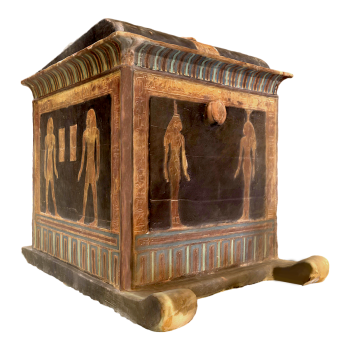
The Second Coffin of Yuya in Ancient Egypt

Yuya was an important figure in the 18th Dynasty of ancient Egypt (15th century BC). His second coffin was found in tomb KV46 in the Valley of the Kings of Egypt and is now preserved in the Luxor Museum. The second coffin is usually an inner or outer coffin used to protect the mummy. The inner coffin (inner coffin) is a smaller coffin located inside the outer coffin, while the outer coffin is a larger and more ornate coffin. These coffins are usually made of wood and are carefully decorated and carved to show the art and religion of ancient Egypt.
The Canopus Box of Yua in Tomb KV46, Egypt

The Canopus Box of Yua in Tomb KV46, Egypt

Yua was an important figure of the New Kingdom period (15th century BC), the father-in-law of the ancient Egyptian pharaoh Thutmose III (Tutmosis III) and the father of the Egyptian queen Tiye. Yua's canopus box preserves Yua's internal organs, including lungs, stomach, liver and kidneys. In ancient Egyptian burial rituals, the organs were placed in four separate canopus boxes for use in the afterlife. Yuya's Canopus box, currently in the Luxor Museum, is a valuable work of art and archaeological artifact, representing the exquisite craftsmanship and cultural traditions of the high Egyptian society of the time.
Vessel in the Form of a Fish from the Middle Nazca Period

Vessel in the Form of a Fish from the Middle Nazca Period

Fish-shaped vessels were made from about 100 BC to 600 AD and are part of the Nazca culture. NASCAR artists are known for their bold, colorful designs. They are keen observers of the world around them and depict many plants and animals in their work, but they seem more concerned with capturing the spirit and vividness of the subject than naturalism. The image of this fish is highly abstract, the scales are suggested by strokes, and the gills are represented by streamlined lines. It is round and fat, proving a rich food supply. Fish is a key component of the Nazca diet and often appears in their art.
Hannifer granite sarcophagus during the reign of Ramses II in 1225 BC

Hannifer granite sarcophagus during the reign of Ramses II in 1225 BC

This sarcophagus is a granite sarcophagus from the reign of Ramses II in 1225 BC. It was found in Hannifer, Egypt, hence the name Hannifer sarcophagus. This sarcophagus is carved from a huge granite monomer. Its dimensions are very large, measuring about 3.7 meters (12 feet) long and weighing about 120 tons. The inside of the sarcophagus was originally empty and no body was found. However, its design and decoration suggest that it was once a funeral vessel for an important person. The exterior of the sarcophagus is decorated with fine reliefs depicting religious and mythological scenes of ancient Egypt. It was given to the Fitzwilliam Museum in Cambridge, England in 1835.
Shang Dynasty Bronze Vessel "Sacrifice to Tripod"

Shang Dynasty Bronze Vessel "Sacrifice to Tripod"

This tripod is a relic of China's Shang Dynasty (1600 BC -1046 BC) and was made from 1200 BC to 1100 BC. The overall size of this bronze vessel is 14.3 x 12.5cm and is currently in the collection of the Cleveland Museum of Art. This tripod has a pattern composed of silkworms and cicadas, which is a typical form and decoration of the late Shang Dynasty. In ancient China, bronze vessels such as the tripod were used to worship the food and meat of ancestors in sacrifices. These bronzes have become the main academic research objects in Chinese history and are precious art treasures.
Fang Ding, now in the collection of the Minneapolis Institute of Art, USA

Fang Ding, now in the collection of the Minneapolis Institute of Art, USA

Fang Ding is an ancient Chinese bronze ware. It is a kind of food vessel with a special shape. The production began in the late Shang Dynasty (11th century BC) in China. Fang Ding played an important role in the social and religious life of ancient China. It is often used as a sacrificial feeding vessel for the worship of gods or ancestors. Fang Ding not only has practical value, but also has artistic value. Its exquisite craftsmanship and exquisite relief patterns show the high technical level of ancient Chinese bronze ware production, and it is one of the precious heritages of ancient Chinese society and culture.
A large ancient Greek pottery basin painted with a Dionysus scene

A large ancient Greek pottery basin painted with a Dionysus scene

It is a large terracotta basin commonly used for mixing wine and can be used for banquets and religious ceremonies. It is made of red terracotta with black and red painted decoration. The Dionysus painted on the basin is the god of wine and drama in ancient Greek mythology, and is considered a symbol of joy, indulgence and banquets. The scenes on the pottery basin usually depict banquets associated with Dionysus, the entourage of the god of wine (also known as Cerenos), and other related mythological scenes. This pottery basin is usually handmade by a potter. It is used as a drinking vessel in feasts and celebrations, and may also be used in religious ceremonies and sacrifices.
Stone oil lamp base unearthed at Broch of Gurness

Stone oil lamp base unearthed at Broch of Gurness

Broch of Gurness is an Iron Age village in the western Orkney Islands, Scotland, about 2,000 years old. This roughly chiseled lamp, once filled with oil, could once provide light from a slow-burning wick. Found in an Iron Age settlement Gurness of Broch.
A 17.14cm tall Japanese Satsuma ceramic vase

A 17.14cm tall Japanese Satsuma ceramic vase

A cream-colored Japanese pottery, produced in Satsuma, Kyushu, began in the late 18th century, with an exquisite cracked glaze and fine decorative patterns of color and gold. Satsuma Burning originated at the end of the 16th century. Satsuma ceramics include official kilns, folk kilns and imperial kilns, distributed in the southern part of Kyushu Island, Japan. In ancient times, it belonged to the state of Satsuma. The vase is painted with the Meiji period (1868-1912) colored enamel and gilded figures of everyday work, with a cock painted on the back amid blooming flowers and trees.
Jingdezhen fish tank with plant and carp decoration

Jingdezhen fish tank with plant and carp decoration

Produced in 1700-1720, China Jingdezhen ceramic aquarium, the use of plants and carp painting, the use of materials for glaze and gold. Currently collected in the National Gallery of Dresden, Germany.
Chinese carp relief teapot produced by Mason ceramic factory in Germany

Chinese carp relief teapot produced by Mason ceramic factory in Germany

Mason porcelain teapot from about 1729-1731. Mason porcelain is the first porcelain in Europe. German "Meissen Mason" is the earliest ceramic factory established in Europe and one of the best porcelain manufacturers in the world. It is called the Rolls Royce of the porcelain industry. Since the birth of "Meissen Mason" porcelain, plaster molds for each product have been preserved, totaling 175000. The exact same product as it was 200 or 300 years ago can be regenerated at any time. 3000 kinds of patterns are also preserved a lot. "Meissen Mason" porcelain is not only a commodity, but also a valuable cultural heritage of Germany.
astronomical observation instrument

astronomical observation instrument

An observational astronomical instrument of the first half of the 19th century used to determine the height of a celestial body above the horizon. It consists of a frame limited by two radii and a graduated arc, an observation telescope and a mirror system. The 1/5 arc is the fifth part of the circle, hence the name, similar to the quadrants, 1/6, and 1/8 (based on the fourth, sixth, and eighth parts of the circle, respectively). It is currently housed in the Jagiellon University Museum in Munich, Germany.
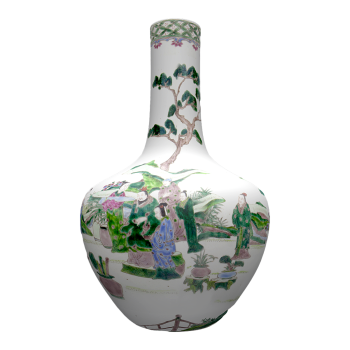
ancient chinese vase

ancient chinese vase

19th Century Victorian Ice Cream Freezer

19th Century Victorian Ice Cream Freezer

Victorian Arctic ice cream freezer/ice cream machine Sears Roebuck's ice cream machine in the 1890 s is made of wooden barrels, metal crank parts and wooden knobs.
The Zhou Dynasty bronze bell at the British Museum

The Zhou Dynasty bronze bell at the British Museum

The bronze bell of the Zhou Dynasty, circa 5th century BC, was unearthed in Henan, China and is now in the British Museum in London. The bronze bell was a relatively common percussion instrument in ancient China, appearing in the early Western Zhou Dynasty, and its form evolved from the crown. The basic form is a suspended handle on the plane of the upper part of the flat resonance box with sharp sides. From the shape of the bronze bell can be divided into two kinds, namely Yong bell and button bell, Yong bell hanging way for oblique hanging, and button bell for straight hanging. A number of bells with different frequencies are listed on the frame in order to form a playable scale, called a "chime".
A red-black glazed clay pot with a handle, circa 6th century BC

A red-black glazed clay pot with a handle, circa 6th century BC

Antique bronze tripod

Antique bronze tripod

Ancient Greek Pottery 3D Model

Ancient Greek Pottery 3D Model

Imitation Minoan civilization bronze 3D model

Imitation Minoan civilization bronze 3D model

"Minoan civilization (Minoan Civilization/The Minoans)" is also translated as Minoan civilization. It appeared in ancient Greece and the Bronze Age before Mycenaean civilization, about 2850 BC -1450 BC. It is the earliest ancient civilization in Europe, but also the precursor of the Greek classical civilization. It is famous for its exquisite palace buildings, murals, pottery and handicrafts.
Three-legged binaural bronze 3D model

Three-legged binaural bronze 3D model

Exquisite copper pot 3D model

Exquisite copper pot 3D model

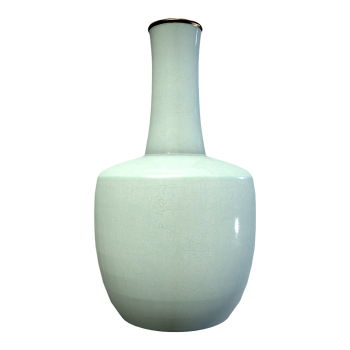
Green Porcelain Jar 3D Model

Green Porcelain Jar 3D Model

Cloisonne enamel three beast foot incense burner 3D model

Cloisonne enamel three beast foot incense burner 3D model