Fossil skeleton of Procaratops

Fossil skeleton of Procaratops

An's protoceratops is a herbivorous dinosaur of the ornithophorosaurid family, which is one of the most representative early horatosaurs in the late Cretaceous. The discovery of its fossils provides key evidence for the study of the evolution and paleoecology of the species, and is known as the "ancestor of the horned dragon". It is mainly found in the Late Cretaceous strata of South Gobi Province, Mongolia; a few fossils are found in Inner Mongolia, China. Inhabit arid to semi-arid grassland or desert environment, prefer low-lying, sparse vegetation area.
calcite

calcite

Calcite chemical formula for CaCO, is the most widely distributed carbonate minerals in nature, belongs to the trigonal system (rhombohedral system), because the crystal is often a rhombohedral (rhombohedral) morphology and named. Its English name "Calcite" is derived from the Latin "calx" (meaning lime), which is the main component of limestone and marble.
pentagonal dodecahedral pyrite crystal

pentagonal dodecahedral pyrite crystal

Pyrite chemical formula for FeS, is the most common representative of sulfide minerals, because the surface is often metallic luster and easy to oxidize "fool's gold" (Fool's Gold) misnomer. Pyrite is one of the most representative crystal forms, which belongs to the icosahedron family of cubic crystal system. It is composed of 12 pentagonal faces (each face is a regular pentagon), and the vertices connect 5 faces. The overall structure of the dodecahedron (similar to the simplified version of the "truncated icosahedron" of football).
Periodic Table of Elements-Covalent Radius

Periodic Table of Elements-Covalent Radius

Periodic Table-Atomic Radius Reduction

Periodic Table-Atomic Radius Reduction

Earth 1:35 million Geological Map

Earth 1:35 million Geological Map

Crystal Systems and Bravig

Crystal Systems and Bravig

The crystal system is divided into seven basic categories according to the macroscopic symmetry of the crystal (such as rotation axis, mirror, inversion center, etc.), which is used to describe the symmetry characteristics of the crystal structure. Bravig is a mathematical model describing the translational symmetry of crystals, proposed by French scientist Auguste Bravie, a total of 14 possible lattice types, divided into seven subclasses under the crystal system. The classification of crystal systems is based on the macroscopic symmetry operation of crystals.
Limonite-encapsulated plate-like barite crystals

Limonite-encapsulated plate-like barite crystals

The limonite-coated plate-like barite is a typical mineral assemblage under the action of epithermal or hydrothermal fluid, which combines the industrial value of barite with the oxidation characteristics of limonite.
Lavolite with color effect

Lavolite with color effect

Lazarite is a kind of mineral in the family of plagioclase (Plagioclase Feldspar). It is a series of similar substances with chemical composition of NaAlSiΑ O₂-CaAl₂ Si₂ O₂, mainly rich in sodium. Its name is derived from the Canadian Labrador region (Labrador), is a common mineral in igneous rocks (such as basalt, granite) and metamorphic rocks. Usually gray, black, green or brown, transparent to translucent. Glass luster, cleavage surface is pearl luster. The crystal system belongs to triclinic system with Mohs hardness of 6-6.5.
Geological Map of Romania

Geological Map of Romania

Romania is located in the northeastern part of the Balkan Peninsula in southeastern Europe, and its geological structure is deeply influenced by the Alpine orogeny, forming a variety of tectonic units and geomorphological types. Main geological regional features: Carpathian Mountains, Transylvania Basin, Lower Danube Plain, Banat Basin. The geological structure of Romania is complex and diverse, combining Precambrian basement, Alpine orogenic belt and young sedimentary basin. Its rich mineral resources, active seismic zones and unique landforms.
Round Bright Cut Diamond (with rotating animation)

Round Bright Cut Diamond (with rotating animation)

Diamond refers to the diamond after pondering, diamond is a natural mineral, is the original stone of diamond. Simply speaking, diamond is a kind of elemental crystal composed of carbon formed under the condition of high pressure and high temperature in the deep part of the earth. Diamonds are the hardest natural substance known in the world. Diamond production is rare, usually colorless crystals, with a high degree of refractive properties, can reflect a colorful luster. Diamonds can be used not only as jewelry, but also as advanced cutting and grinding materials in industry.
3D diagram of crystal morphology classification

3D diagram of crystal morphology classification

Crystal Morphology and Structure of Quartz

Crystal Morphology and Structure of Quartz

Quartz (Quartz) is a silicon dioxide (SiO₂) stable homogeneous polymorphic variants, belonging to the three-party crystal system (Trigonal System), the crystal form to hexagonal columnar, often accompanied by conical, rhombohedral or double cone symmetry elements.
Crystal structure of graphite

Crystal structure of graphite

Graphite is another allotrope of the element carbon (C) with a typical layered hexagonal structure. Its structure is composed of carbon atoms through sp² hybridization to form a hexagonal honeycomb planar layer, and the layers are combined by weak van der Waals forces. Hexagonal crystal system, space group: P6/mmc, unit cell parameter a ≈ 2.46 Å (bottom side length) c ≈ 6.70 Å (layer spacing), and the number of atoms in each unit cell is 4 carbon atoms. Natural graphite is used as a moderator for batteries, electric arc furnaces, and nuclear reactors because of its low neutron absorption cross section.
Crystal structure of diamond

Crystal structure of diamond

Diamond (Diamond) is an atomic crystal with a cubic crystal system composed of carbon (C) elements, and its structure is one of the hardest natural materials in nature. Crystal system cubic crystal system (equiaxed crystal system) space group Fd3m (face centered cubic structure) unit cell parameter a ≈ 3.57 Å (unit cell edge length) The number of atoms in each unit cell is 8 carbon atoms, and each carbon atom is connected to another 4 carbon atoms through covalent bonds to form a tetrahedral configuration. All carbon atoms are located in the apex and face-centered positions of the cubic unit cell, as well as the four inner positions (alternating distribution).
brown pyroclastic with porphyrite

brown pyroclastic with porphyrite

Pyroclastic is a porous, light pyroclastic rock formed by rapid cooling after the eruption of basaltic magma. Black, dark gray or brown (depending on the degree of oxidation). Rich in pores (bubbles), loose texture, low density. Basalt, containing pyroxene, plagioclase and other dark minerals.
African Forest Elephant Skull

African Forest Elephant Skull

The African forest elephant is an independent species of the genus African Elephant (Loxodonta), with significant genetic and morphological differences from the larger African steppe elephant (Loxodonta africana). Mainly distributed in the central and western African tropical rainforest areas, such as the Congo Basin, Gabon, Cameroon and other places in the dense forest.
spotted deer specimen

spotted deer specimen

The spotted deer (scientific name: Axis axis) is an even-hoofed animal of the genus Deer, Deer. Standing shoulder height 0.6-1 meters, body length of about 1.5 meters. Bucks horns, trifurcated, up to 75cm long. This species has a red body color and white on the abdomen, inside of the legs and under the short tail. Males tend to be darker in color and have black markings on their faces. Characteristic white patches appear in both sexes and extend in longitudinal rows throughout the animal's life. A black dorsal stripe runs across the animal's back.
Spanish Goat

Spanish Goat

Goat (scientific name: Capra hircus) is a mammal of the genus Bovine Goat. Also known as summer sheep, black sheep. There are more than 150 goat breeds in the world, including dairy goat and hairy goat; there are more than 40 goat breeds in China, including Yimeng black goat and Cangshan black goat. The goat has a compact structure, a deep and broad chest, arched ribs, a straight back and waist, a large abdomen without drooping, regular limbs, strong bones, well-developed and elastic breasts, and large and neat nipples. Tip of mouth, sharp teeth, thin lips. Both male and female sheep have horns and beard. The coat is mostly white, accounting for more than 85%, the outer layer is coarse hair and the inner layer is fluff.
Twisted Horned Forest Antelope Specimen

Twisted Horned Forest Antelope Specimen

The hornbeam antelope is a mammal of the genus Bokolinga in the order Artiodactyla. The fur is predominantly gray, with a white streak with distinct V-shaped white hairs on the nose and small white dots on both sides of the face. The ears are funnel-shaped, with long laryngeal spikes; only males have horns, the horns 1.7 meters long. The average life expectancy is 8-12 years. The horned antelope is distributed in eastern to southern Africa. It inhabits translucent forests or dense irrigation, often in mountainous or rocky areas. Active diurnal, 5-6 females form groups without rank, while 2-10 males form single groups. Vegetarian animals that feed on leaves, plants, tubers, flowers, and fruits.
Iranian Sheep Specimen

Iranian Sheep Specimen

Ovine (Ovis aries) is a mammal of the genus Ovine in the family Boviidae, in the order Artiodactyla. The body is plump and covered with dense hair. Short head; Rams have large spiral horns, ewes have no horns or small horns; The skull has a tear socket and the nasal bone is relatively raised. Four hooves have toe glands; The tip of the mouth and lips are thin and flexible. Weight ranges from tens of kilograms to more than 100 kilograms, with a natural life span of about 15 years.
lazy bear specimen

lazy bear specimen

The lazy bear is a mammal of the genus lazy bear in the order Carnivora, with a black body, rarely dark brown or reddish brown, a crescent-shaped white spot on the chest, and a light-colored nose and face. The hair is long and messy. Under feeding conditions, life can reach 40 years. The sloth bears are found in Sri Lanka, India, Nepal and Bhutan. It inhabits early and humid forests, shrubs, savannas and grasslands, mostly below 1500 meters above sea level, and occasionally up to 2000 meters above sea level, such as the Western Ghats in India. It feeds mainly on termites, but also on small vertebrates, fruits, and insects.
sheep specimen

sheep specimen

Ovine (Ovis aries) is a mammal of the genus Ovine in the family Boviidae, in the order Artiodactyla. The body is plump and covered with dense hair. Short head; Rams have large spiral horns, ewes have no horns or small horns; The skull has a tear socket and the nasal bone is relatively raised. Four hooves have toe glands; The tip of the mouth and lips are thin and flexible. Weight ranges from tens of kilograms to more than 100 kilograms, with a natural life span of about 15 years.
Specimen of the Horned Antelope

Specimen of the Horned Antelope

The ornis belong to the bovidae. The neck of the horned antelope is relatively short, and the shoulder is slightly higher than the hip. The limbs are thicker and the feet are wide. The tail is round and thin, 25-35cm long, with long hair at the end. The hair in winter is long and rough, mainly grayish brown, and the hair in summer is sandy yellow. The forehead of the head has large black tufts of hair. Small eyes; The horns of both male and female are about 80cm long and female, and female, and female, which are relatively thin, curved posteriorly and then upward, respectively, and slightly resembled a flat spiral. There is also an easy to identify feature, in their forehead has a much darker than the body hair color, and the face hair is whiter than the body hair.
goat specimen

goat specimen

Goat (scientific name: Capra hircus) is a mammal of the genus Bovine Goat. Also known as summer sheep, black sheep. There are more than 150 goat breeds in the world, including dairy goat and hairy goat; there are more than 40 goat breeds in China, including Yimeng black goat and Cangshan black goat. The goat has a compact structure, a deep and broad chest, arched ribs, a straight back and waist, a large abdomen without drooping, regular limbs, strong bones, well-developed and elastic breasts, and large and neat nipples. Tip of mouth, sharp teeth, thin lips. Both male and female sheep have horns and beard. The coat is mostly white, accounting for more than 85%, the outer layer is coarse hair and the inner layer is fluff.
Early twentieth century measuring instruments antique theodolite

Early twentieth century measuring instruments antique theodolite

Universal solar ring for astronomical instruments in the eighteenth century

Universal solar ring for astronomical instruments in the eighteenth century

This instrument was manufactured around 1760 and was one of the most advanced astronomical measurement tools of the time. By using the Universal Dayring, astronomers can accurately measure the position of the sun during the day to determine time and orientation. This instrument was widely used in the 18th century to help astronomers with celestial observation and navigation.
Triangulation theodolite made in 1902

Triangulation theodolite made in 1902

The triangulation theodolite is a precision measuring tool used to measure horizontal and vertical angles, especially in the field of geographic mapping and engineering. The triangulation theodolite of 1902 is the representative of the advanced surveying and mapping technology at that time, with higher accuracy and stability.
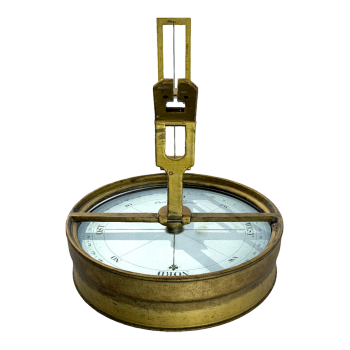
Eighteenth-century measuring instrument theodolite
Eighteenth-century measuring instrument theodolite

A theodolite is a precision instrument used to measure horizontal and vertical angles. It was made in 1752 and is commonly used in geographic mapping and engineering. Theodolite belongs to the early measuring instrument, which is very precise in design and technology, which laid the foundation for the later measuring instrument. In the 1752 theodolite, craftsmen used precision machining techniques to ensure the accuracy of the measurement. These early theodolites played an important role in geographic mapping, engineering construction and astronomical research, helping people to accurately determine position and angle.
nineteenth century instrument mapping surveying compass

nineteenth century instrument mapping surveying compass

The measuring compass was made around 1820. This is an instrument used to measure and map terrain. The measuring compass combines the functions of a compass and a measuring instrument and can measure angles and orientations for mapping and location determination. At the beginning of the 19th century, this instrument was widely used in geological exploration and engineering survey. This instrument was designed to make precise measurements in the field environment and was an important tool for geologists, engineers and surveyors at the time.
eighteenth-century astronomical equipment reflecting telescope

eighteenth-century astronomical equipment reflecting telescope

The main component of a reflecting telescope is a concave mirror (primary mirror), which reflects light to the focal point. Unlike refracting telescopes, reflecting telescopes use mirrors instead of lenses to focus light, which avoids chromatic aberration problems. Common reflecting telescope designs include the Newtonian and Cassegrain telescopes. Reflecting telescope design was further developed in the 18th century, particularly with large aperture and high power reflecting telescopes. The use of a parabolic mirror allows the light rays parallel to the optical axis of the objective lens to be accurately focused on the focal point, thereby greatly improving the image quality.
Ophthalmoscope, an ophthalmic instrument invented in 1850

Ophthalmoscope, an ophthalmic instrument invented in 1850

The ophthalmic instrument, Helmholtz also known as the ophthalmoscope, was invented in 1850 by the German scientist Hermann von Helmholtz (Hermann von Helmholtz). The main function of this instrument is to allow ophthalmologists to observe the retinal details of the living eye. The ophthalmoscope allows the doctor to see the structures inside the eye by reflecting light that enters the pupil. The invention of this instrument has greatly promoted the development of ophthalmology, allowing doctors to diagnose eye diseases and prevent them. Before Helmholtz invented the ophthalmoscope, doctors could not see the posterior pole of the retina in the eye of a living patient.
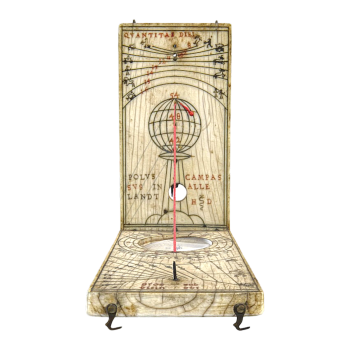
16th century astronomical instrument sundial
16th century astronomical instrument sundial

Seventeenth Century Astronomical Instrument Hand-held Folding Ivory Sundial

Seventeenth Century Astronomical Instrument Hand-held Folding Ivory Sundial

Seventeenth Century Astronomical Instruments Small Ring Sundial

Seventeenth Century Astronomical Instruments Small Ring Sundial

The ring sundial was a sophisticated instrument used to measure time at the time. Its design combines science, technology and art, symbolizing the era's quest for time and astronomical knowledge. The working principle of the ring sundial is based on the position of the sun, and the time is determined by reading the projection of the sun on the dial.