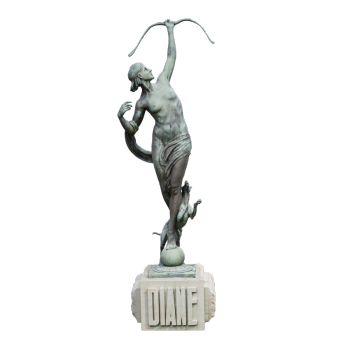
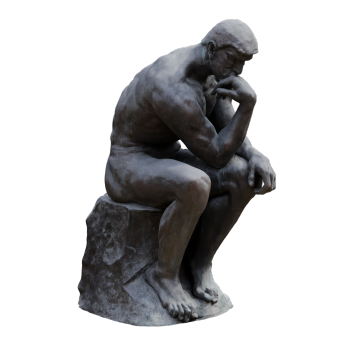
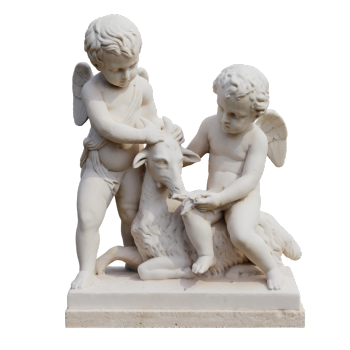
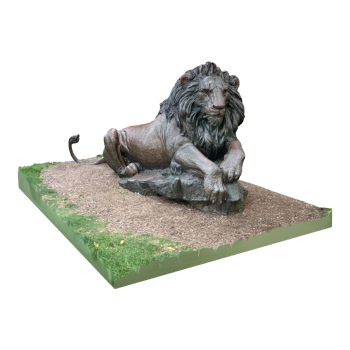
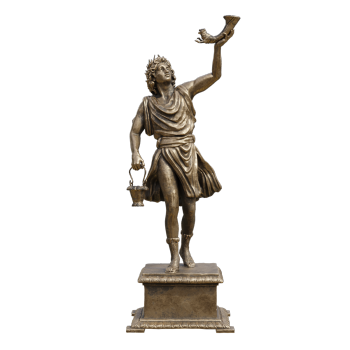
Paris Luxembourg Park "Arion assis sur un Dauphin" Arion sitting on a dolphin

Paris Luxembourg Park "Arion assis sur un Dauphin" Arion sitting on a dolphin

The Chu musical instrument "Tiger Seat Phoenix Frame Hanging Drum" from the Warring States period

The Chu musical instrument "Tiger Seat Phoenix Frame Hanging Drum" from the Warring States period

Tiger Phoenix Frame Hanging Drum, also known as Tiger Phoenix Frame Hanging Drum or Tiger Bird Frame Drum. Excavated from Tomb No. 2 of the Warring States Chu Dynasty in Jiuliandun, Hubei, it is a typical representative artifact of Chu musical instruments. This is one of the largest tiger shaped phoenix frame drums excavated from a Chu tomb in China. Its height is about 1 meter, with symmetrically arranged double phoenixes and double tigers as the drum frame. The base consists of two crouching tigers with their backs facing each other, with a phoenix standing on each tiger's back. The Tiger Seat Phoenix Frame Hanging Drum was an important type of musical instrument in the Chu state during the Warring States period. It is a lacquerware from the Eastern Zhou Dynasty, unearthed from Tomb No. 2 of Jiuliandun in Zaoyang City, Hubei Province. It is an exquisite handicraft that combines lacquer, carving, and painting techniques organically.
Armor Set

Armor Set

Armor is a tool used by humans to protect their bodies during armed conflicts, also known as armor or armor. Both helmets and armor refer to protective gear for the head; Armor and armor are protective gear for the body, mainly used to protect important organs in the chest and abdomen. Armor, from the unearthed objects, ancient war armor was mostly made of leather such as rhinoceros and shark, and painted on top; Leather armor consists of a body, sleeves, and skirt; The stitching method of the nail plate is to horizontally press the left plate against the right plate, and vertically press the lower plate against the upper plate; The armor is also woven with eighteen pieces of armor.
Changsha Kiln Lion Candlestick "created by Hu Wuqiang

Changsha Kiln Lion Candlestick "created by Hu Wuqiang

The Tang Dynasty Changsha kiln blue glazed brown green colored lion shaped candle holder has a height of 13.2 centimeters, a diameter of 2.2 centimeters, and a base diameter of 9.8 centimeters. The device is in the shape of a sheep, with vertical ears, closed mouth, rolled tail, and a horizontal view. Carrying a cylindrical candle tube, crouching on the carved throne with bent limbs. Round seat, flat bottom. The front, left, and right sides of the abdomen each have pointed leaf shaped doors, which resemble the shape of a lion. The tire is gray and white in color, with light brown green stripes on the body and a light yellow green glaze on the outer cover. The device has a stable shape, a gentle and cute animal image, and colorful glaze decoration. Early celadon candle holders were mostly shaped like animals. During the Three Kingdoms period, there were also sheep shaped candlesticks.
Why was born into slavery, created by Jean Baptiste Calvo

Why was born into slavery, created by Jean Baptiste Calvo

As one of the most powerful expressions of abolitionist sentiment in visual art, "Why Born Enslaved!" depicts an African woman who is bound by ropes and provocatively looks up. The rope painfully pressed against her breasts; Her tattered shirt hinted at the violence that caused her illness. The original colored surface is covered with complex and intricate shadows and subtle shapes. There is evidence to suggest that this masterpiece of 19th-century French sculpture is the primary model for numerous castings in other museum collections. It is currently housed in the Cleveland Museum of Art.
The sitting statue of Shakyamuni Buddha during the Guishuang Empire period

The sitting statue of Shakyamuni Buddha during the Guishuang Empire period

The Kushan Empire was an ancient prosperous country that existed in Central and South Asia. During its peak period (105-250 AD), its territory extended from present-day Tajikistan to the Caspian Sea, Afghanistan, and the Ganges River basin. Guishuang is a branch of the Dayue people who lived in the Amu Darya and Syr Darya river basins in the 2nd century BC. In 130 BC, the Yue people migrated south to conquer Daxia and divided it into five tribes, each with a chief called the Marquis of Xi. The Guishuang Xiahou Qiu, one of the Five Xiahou, eliminated the other Xiahou, unified the five tribes, and established the Guishuang Kingdom. However, Qiu defeated Anxi and attacked the Kabul River Basin and Kashmir region southward, eventually establishing the capital as Gaofu.
Shang Dynasty Sanxingdui bronze ware "Shang Bronze Man Head"

Shang Dynasty Sanxingdui bronze ware "Shang Bronze Man Head"

This cultural relic is a bronze ware from the Shang Dynasty, with a human head of Fang Yi. It comes in two types: flat topped and round topped, with large or vertical ears and perforated earlobes. Garlic nose, wide mouth, and thick neck. Wrap the hair backwards and add braids or hair accessories to the back of the head. It is currently collected in the Sanxingdui Museum.
Ming Ming Mausoleum and Ming Maoling Statue "Stone Carving of Benevolent Beasts"

Ming Ming Mausoleum and Ming Maoling Statue "Stone Carving of Benevolent Beasts"

Starting from the two hexagonal stone pillars to the north of the Beiting Pavilion and ending at the Dragon and Phoenix Gate, on both sides of the kilometer long divine path, 24 stone beasts and 12 stone figures are neatly arranged, with vivid shapes and exquisite carvings, deeply loved by tourists. The large quantity, large size, exquisite carving, and good preservation of it are rare in ancient Chinese cemeteries. The stone figures are divided into four categories: meritorious officials, civil officials, and military officials, each with four statues. They were close attendants of the emperor during his lifetime, all of whom were standing statues with hands clasped in water, majestic and devout. The installation of such stone statues in imperial tombs dates back over two thousand years to the Qin and Han dynasties.
The specimen of Tyrannosaurus rex fossil at the Vienna Museum of Natural History

The specimen of Tyrannosaurus rex fossil at the Vienna Museum of Natural History

Tyrannosaurus belongs to the Tyrannosaurus genus of the Tyrannosauridae superfamily and is the only species in this genus. It was named in 1905 by American paleontologist and member of the American Academy of Arts and Sciences, Henry Osborne. If we refer to the translation format of other dinosaur species, it would be more appropriate to translate its species name as' King Tyrannosaurus'. Adult Tyrannosaurus rex is about 12 meters long and weighs around 7 tons, making it one of the largest land predators in Earth's history. This specimen fossil is currently preserved at the Vienna Museum of Natural History.
Dying Gladiator Stone Carving

Dying Gladiator Stone Carving

This sculpture depicts a dying gladiator who displays elegance and dignity in the face of death, gazing at the crown he has earned for his courage. This sculpture was created by French sculptor Pierre Julien (June 20, 1731- December 17, 1804) and was his second entry into the Royal Academy of Painting and Sculpture. It was a crucial work for him. This sculpture is currently on display at the Louvre Museum in Paris, France.
The Spanish Civil War Memorial "Eric Stanford"

The Spanish Civil War Memorial "Eric Stanford"

A fully restored Spanish Civil War memorial has been put back into use in Forbury Gardens. Reading Mayor Tony Jones presided over the event in the monastery district, with representatives from the borough council, unions, and other local groups also attending. The ceremony was held almost 25 years after the statue was first unveiled in May 1990. This monument was created by local sculptor Eric Stanford and, after four years of fundraising, depicts the mothers of those who died in Spain during the 1936-39 Civil War. At least 16 people from or associated with Reading were killed in the battle.
The Piet à da Palestrina marble statue of the Virgin Mary in Palestrina

The Piet à da Palestrina marble statue of the Virgin Mary in Palestrina

Piet à da Palestrina "is a marble sculpture from the Italian Renaissance period, dating back to around 1555 AD. It is currently on display at the Accademia Gallery in Florence. This sculpture depicts three characters, one of which is the body of Jesus Christ. This sculpture was attributed to Michelangelo's work in the first half of the 18th century.
The specimen plate dinosaur fossil specimen at the Vienna Museum of Natural History

The specimen plate dinosaur fossil specimen at the Vienna Museum of Natural History

Banlong is an ancient dinosaur from the Triassic period, which lived between 222 million and 200 million years ago. It was the first giant dinosaur to appear on Earth. Before the appearance of the Banosaurus, the largest herbivore had a body size as big as a pig, while the Banosaurus was much larger, with a body the size of a bus. Banlong, meaning "flat reptile," is an ancient dinosaur that lived 210 million years ago during the Late Triassic period. It has a body length of 6-8 meters, a height of 3.6 meters, and a weight of about 5 tons. According to archaeological research, it was the first giant dinosaur that lived on Earth and ate plants. The specimen is currently preserved at the Vienna Museum of Natural History.
Atlas stone carving

Atlas stone carving

Atlas is located in front of the new castle on Lake Kitt. There are eight powerful Atlas supporting the balcony like porch, which was built by the Earl Joseph Batty á ny at the beginning of the 20th century. Atlas is a kind of prop that replaces a pillar with a muscular male image. Its name comes from Atlas, the sky lifter in Greek mythology.
European style blue dress porcelain doll sculpture ornament dress girl

European style blue dress porcelain doll sculpture ornament dress girl

Portrait statue of a Cypriot man

Portrait statue of a Cypriot man

This statue is a portrait of a man from Cyprus, made around 350 to 250 BC. This statue was discovered in the Apollo Temple and has a height of 50.50 centimeters. It is now on display in the British Museum.
Marble statue of the head of a man with long beard

Marble statue of the head of a man with long beard

This marble statue is the head of a bearded man, possibly representing the ancestors of King Mausollos. This work was discovered around 350 BC in the main sculptural sediment north of the North Peripolis Wall, carved from marble. This statue is now on display at the British Museum.
The Madonna and Child painting created by Michelangelo

The Madonna and Child painting created by Michelangelo

Michelangelo Bonaroti's painting of the Virgin Mary, created around 1547-1555. The Cathedral Opera House Museum in Florence, Italy. This painting of the Virgin Mary is Michelangelo's penultimate sculpture. In 1555, the elderly Michelangelo destroyed this sculpture after discovering a defect in the marble. In 1671, Cosimo III de 'Medici purchased the reconstructed sculpture and placed it in the basement of San Lorenzo Cathedral. In 1722, it was transferred to the Florence Cathedral.
Marble bust of Roman Emperor Marcus Aurelius

Marble bust of Roman Emperor Marcus Aurelius

This marble statue is the bust of Roman Emperor Marcus Aurelius, wearing a tassel cloak. The height of this statue is 73.66 centimeters and it comes from Jason Magnus' house. The production date of this statue is approximately between 160 and 170 AD. This statue is now on display at the British Museum.
Lucius relief bust

Lucius relief bust

This Roman stone tomb relief depicts Lucius Antius Philomorsus, his daughter, and his wife. The relief is depicted in the style of the Roman Republic. The production date of this work is from 15 BC to 5 AD, and the dimensions are: height of 61 centimeters, width of 165 centimeters, and depth of 18.5 centimeters. This relief is currently housed in the British Museum.
The bust of Demosthenes, a sculpture from the ancient Greek period in the 3rd century BC

The bust of Demosthenes, a sculpture from the ancient Greek period in the 3rd century BC

Demosthenes studied rhetoric from Isseus in his early years and taught rhetoric to Xuan. Subsequently, he engaged in political activities and strongly opposed Macedonia's invasion of Greece, delivering speeches such as the "Anti Philip Speech" to condemn the expansionist ambitions of Macedonian King Philip II. After the Battle of Catalonia (338 BC), he fled overseas. In 323 BC, Alexander III of Macedonia died and returned to Athens to organize an anti Macedonian movement. After failing, he committed suicide. The statue is currently housed in the Louvre Museum.
Monument to the Republic of Paris, 1879 National Square Monument

Monument to the Republic of Paris, 1879 National Square Monument

Ten years before the 100th anniversary of the French Revolution, the city of Paris launched a competition for the Honor Monument of the New Republic located in the east of Paris. The Morris brothers won the competition, and their Republic Monument is now located on Republic Square. But Jules Darrow's project attracted Paris city councilors, who commissioned him to make bronze for the current Place de la Nation. The victory of the Republic opened in 1899. As a fervent republican, Dalloway chose to provide impetus for his monument, leading humanity towards a new golden age.
Qing Dynasty Qianlong period vase "Carving Peacock Stone Vase"

Qing Dynasty Qianlong period vase "Carving Peacock Stone Vase"

The Qianlong seal is located within the square border on the bottom. In the form of a water basin decorated with character patterns and dragons, surrounded by flower branches.
Chinese white ceramic birthday star painted statue

Chinese white ceramic birthday star painted statue

Shouxing, also known as the Antarctic Elder Star, is the god of longevity in ancient mythology. He is also a deity in Taoism, originally named Xingxing and one of the three stars of fortune, fortune, and longevity. After Emperor Qin Shi Huang unified the world, he built the Shouxing Temple in Du County near Chang'an. The late birthday star evolved into the name of an immortal. The Ming Dynasty novel "Journey to the West" depicts the birthday star holding a lingzhi mushroom, with a long head, large ears, and a short body. The "Warning to the World" has a mythological story of "three stars of fortune, wealth, and longevity". The birthday star in the portrait is an old man with white beard, holding a staff and a raised forehead. The ancients symbolized the longevity of the elderly. Often accompanied by deer, cranes, immortal peaches, etc., symbolizing longevity.
The sculpture "Aphrodite" from the ancient Roman Empire period

The sculpture "Aphrodite" from the ancient Roman Empire period

Aphrodite, also known as Aphrodite in Greek, is the goddess of love and beauty in ancient Greek mythology. She is also the goddess of sexuality and one of the twelve Olympian gods. Because it was born in the ocean, it is sometimes revered as a patron saint for navigation. Aphrodite was born on the waves of the sea, with porcelain like skin, blonde hair and blue eyes, and the perfect figure and appearance of ancient Greek women, symbolizing the beauty of women and considered the highest symbol of female physical beauty. It is currently housed in the Capitoline Museum.
The cast iron statue of the Sphinx in front of the French Military Museum

The cast iron statue of the Sphinx in front of the French Military Museum

The Sphinx statue stands between museums and streets in Paris. Made by Ducel Foundry, which was one of the most important foundries in France at that time.
The plaster statue of the dancer from the Sevres porcelain factory in France

The plaster statue of the dancer from the Sevres porcelain factory in France

The "Dancer" was made around 1900 at the Sevres Porcelain Factory in France by Agathon Leonard. It is currently housed in the Smithsonian Institution.
The porcelain "Double Tube Cast Pottery Pot" collected by Teddy Hahn

The porcelain "Double Tube Cast Pottery Pot" collected by Teddy Hahn

The pouring container is spherical in shape and coated with dark brown, beige, terracotta, and green colors. It contains two stirrup like connecting nozzles and is decorated with two animal shaped figures. The subject displays a personified face, possibly depicting a sun. This ship may have come from Moche, and this porcelain was collected by Teddy Hahn.
British steel combat helmet Brody helmet during World War I

British steel combat helmet Brody helmet during World War I

The Brody helmet is a steel combat helmet designed and patented by John Leopold Brodie in London in 1915. Its improved form became the British helmet, steel helmet, Mark I, and the American M1917 helmet. Simply put, it is known as the shrapnel helmet, combat pitcher, Tommy helmet, tin hat, and in the United States, it is called the Dough Boy helmet. It is also known as a disc hat, tin hoop hat, washbasin, combat bowling (when worn by officers), and Kelly helmet.
Daniel Chester Franky's sculpture 'Soul of Life'

Daniel Chester Franky's sculpture 'Soul of Life'

Creative Ornaments: Four No Little Monks Don't Say Little Shami Statue Ornaments

Creative Ornaments: Four No Little Monks Don't Say Little Shami Statue Ornaments

The marble statue "Ugolino and His Sons" collected in the Rodin Museum in Paris

The marble statue "Ugolino and His Sons" collected in the Rodin Museum in Paris

Ugolino and his sons are Ugolino marble sculptures made by Jean Baptiste Carpeaux in Paris in the 1860s. It depicts the story of Ugolino in Dante's Inferno, where a 13th century Count is imprisoned and starving with his children. This work is known for its expressive details, which opened up Karbo's career. It is currently housed in the Rodin Museum in Paris.
Naughty house garden goblin statue resin goblin statue outdoor decoration

Naughty house garden goblin statue resin goblin statue outdoor decoration

The Terracotta Disc "Festus Disc" on the Greek island of Crete

The Terracotta Disc "Festus Disc" on the Greek island of Crete

The Festus disk, also known as the Festus disk, Festus disk, Festus disk, or Festus disk, is a clay disk from the 17th century BC. It is a 6.5-inch diameter terracotta disk with 241 hieroglyphs engraved on both sides, arranged in a spiral pattern from the outside to the inside. The Festus disk is a clay disk discovered on the island of Crete, dating back to around 2000 BC. However, its origin, meaning, and purpose remain a mystery. There are a total of 241 imprints on the disc representing 45 different symbols, some of which represent people, animals, plants, and tools.
Academy Award Trophy

Academy Award Trophy

The appearance of the Hong Kong Film Awards is that of a naked man, with his hands crossed in front of his chest, holding a long sword, standing on a five ring film disc, each ring representing an important department of the Academy of Film and Arts: production, director, screenwriter, actor, and technician. The original trophy was awarded $500 by Mayer to George Stanley for production. It was thirteen and a half inches tall, weighed six and three-quarters of a pound, and was made of alloy. The exterior was silver with a layer of gold foil, which looked shiny, hence it was called the Golden Statue Award.