The carved stone pillar of Notre Dame Cathedral in Paris depicts the marble statue of Jesus

The carved stone pillar of Notre Dame Cathedral in Paris depicts the marble statue of Jesus

The Saint Etienne Gate of Notre Dame Cathedral in Paris is located south of the Seine River. The door depicts the life of the first Christian martyr, Jesus, through colorful paintings. It uses a butt joint arc to support the top of the cathedral walls, enhancing stability and solving the problem of no runoff rainwater discharge.
Nanhai Guanyin Bodhisattva Buddha Statue Standing Statue Guanyin Bodhisattva Dehua White Porcelain

Nanhai Guanyin Bodhisattva Buddha Statue Standing Statue Guanyin Bodhisattva Dehua White Porcelain

Cupid statue at the Amsterdam National Museum

Cupid statue at the Amsterdam National Museum

Pure copper lion ornament, all copper sculpture, brass stone lion

Pure copper lion ornament, all copper sculpture, brass stone lion

Maitreya Buddha Pure Copper Buddha Statue Ornament Gold Bag Laughing Face Buddha Bag Monk

Maitreya Buddha Pure Copper Buddha Statue Ornament Gold Bag Laughing Face Buddha Bag Monk

Baltimore City Monument Statue 'Mrs. Baltimore'

Baltimore City Monument Statue 'Mrs. Baltimore'

Lady Baltimore is located on the Battle Monument in the city center. Italian sculptor Antonio Capellano created the marble statue 'Mrs. Baltimore' in 1815. In the same year, this monument was adopted as the emblem of Baltimore, which also helped to give rise to the city's nickname "Memorial City". Interesting fact: Mrs. Baltimore's figure can be seen on the trash cans throughout the city.
Black, orange, yellow vase from the ancient Roman Empire period

Black, orange, yellow vase from the ancient Roman Empire period

Third century Roman Empire helmet "Inlaid Golden Cavalry Helmet Nidbieber Style"

Third century Roman Empire helmet "Inlaid Golden Cavalry Helmet Nidbieber Style"

The type of cavalry helmet is the Niederbieber style, with hinged X-bars and long neck guards. Fold the edge of the neck protector (upwards) to create a clear edge impression. The helmet is currently housed in the Nijmegen Museum in the Netherlands.
Late Shang Dynasty marble sculpture "Double sided bird faced tube of marble carving"

Late Shang Dynasty marble sculpture "Double sided bird faced tube of marble carving"

This pole decoration with two owl heads is the same as R005055. The owl faces on opposite sides are identical and separated by carved lines. The shape of the head is a top heavy, top light trapezoid. The curved beak of an owl is presented in deep relief and decorated with raised lines and jagged edges. The owl's horns, ears, and chin are depicted in low relief. The owl has eyes engraved in the shape of "chen". The top and bottom of the cultural relic are not decorated, with a diamond shaped top and an oval shaped bottom. Passing through the middle of the artifact is a tubular hole with parallel grinding tool marks on its inner wall, and it is suspected that the hole was created using tubular drilling technology.
The Tang Dynasty musical instrument "Five stringed Pipa"

The Tang Dynasty musical instrument "Five stringed Pipa"

The pipa originated in China and is generally a four stringed instrument. The five stringed instrument is specifically called the five stringed instrument. The "Book of Rites and Music" in the Old Book of Tang states: "The pipa, five stringed instrument, and Kabuki have been loved since Wenxiang, and have been particularly popular since the Heqing period." The five stringed pipa was a plucked string instrument played by a few ethnic groups in northern China in ancient times. Abbreviated as Wuxian. With a long history and unique design, it was popular in the vast Central Plains region of China during the Tang Dynasty and spread eastward to Japan, becoming a historical witness to cultural exchanges between China and Japan.
Marble stone lion in front of the town house

Marble stone lion in front of the town house

Chinese white ceramic painted sculpture of the God of Wealth

Chinese white ceramic painted sculpture of the God of Wealth

In Chinese Taoism, the God of Wealth is the deity responsible for managing the wealth of the world. In Chinese folk customs, New Year's Eve is the busiest day of the Spring Festival. On New Year's Eve, people eat dumplings and stay up all night, waiting to pick up the God of Wealth. Some even bring the God of Wealth to their doorstep, and on the second day of the lunar new year, they also offer sacrifices to the God of Wealth. Nowadays, it is most popular to welcome the God of Wealth on the fifth day of the first lunar month. The God of Wealth worshipped includes the God of Wealth, the God of Wealth, and the God of Wealth, such as Zhao Gongming and Guan Gong; The God of Wealth is Bi Gan, Fan Li, and others. The gods of wealth that people believe in include the Five Saints, Chai Rong, Caigong Caimu, Hehe Erxian, Lishi Xianguan, Wenchang Emperor, and Living God of Wealth Shen Wansan. Among them, the belief in the Wenwu God of Wealth and the Five Saints is the most widespread.
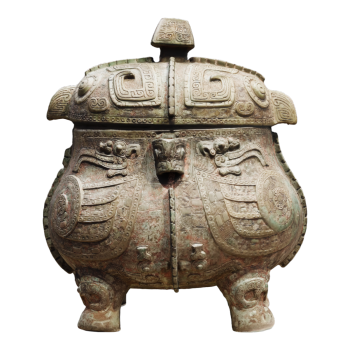
Bronze ware from the Zhou Dynasty, "Zhou Dynasty Food Utensils - Tripod"

Bronze ware from the Zhou Dynasty, "Zhou Dynasty Food Utensils - Tripod"

The tripod is regarded as a symbol of national importance, power, and prestige. The character "tripod" is also endowed with extended meanings such as "distinguished", "noble", and "grand", such as "one word nine tripods", "famous name", "peak period", "strong assistance", and so on. It is also a ceremonial vessel for recording achievements. During major celebrations or receiving rewards, the rulers or nobles of the Zhou Dynasty would cast cauldrons to record the grand occasion. This kind of etiquette still has a certain influence today.
Ceramic "Three Colored Double Dragon Zun" from the Tang Dynasty

Ceramic "Three Colored Double Dragon Zun" from the Tang Dynasty

This statue is a vessel used by Tang Dynasty nobles to serve alcoholic beverages. The authentic product was created during the prosperous Tang Dynasty and was unearthed from a Tang tomb in Luoyang. It has now been circulated among the people. The upper half of the statue is glazed with yellow, green, and white spots, while the lower half is plain. Pankou, neck tied, round shoulder, bulging belly, flat bottom, with symmetrical double dragon handles carved between the shoulder and the mouth, symbolizing "two dragons playing in the water". The shape is full and vivid. This exhibit is currently housed in the Luoyang Tang Sancai Ceramics Museum. First stored in the Tang Sancai Ceramics Museum in Luoyang.
Ceramic Tile at the Top of the White Tower at Zhakou during the Song Dynasty

Ceramic Tile at the Top of the White Tower at Zhakou during the Song Dynasty

The Zhakou White Pagoda is entirely carved and built with white stone, and is a carved tower in the style of a wooden tower. At the bottom of the tower is the pedestal, carved with patterns such as mountain peaks and waves, symbolizing the "Nine Mountains and Eight Seas", with a Sumeru pedestal standing on top. The waist of the tower seat is engraved with Buddhist scriptures, and the tower body is decorated with reliefs of Buddha, Bodhisattva, and stories of sutras, with vivid character images. The Zhakou White Pagoda is a typical example of a wooden tower architecture from the late Northern Song Dynasty, and therefore has high research value.
Vase "Vase - Women and Fish" made by Jean Coulon

Vase "Vase - Women and Fish" made by Jean Coulon

Coarse ceramic made by Jean Coulon in 1902. 27 centimeters high; The bouquet vase with a diameter of 15.8 centimeters depicts a naiad holding a fish and opening its mouth in her arms. Yellow, brown, and green spots cover the entire area. This is a strange female figure, twisted, embracing this sea monster with an open mouth. Here, the artist created a statue without hesitation, cleverly utilizing the plasticity of coarse pottery. Collected in the Sant Museum,
The "Monchanen Vase" produced by the S è vres National Manufacturing Plant

The "Monchanen Vase" produced by the S รจ vres National Manufacturing Plant

The size of this vase is quite slender and simple, with a blue white background and white flowers with blue stems on top. At the base, there is a blue large leaf decoration with fine lines, while the long stem rises towards the neck and blooms with small white flowers. The simplified floral decoration, while appropriately reminiscent of soapberry flowers, emphasizes the slender lines of the vase, with the bouquet blooming on the shoulders. Currently collected at the Saints City Museum.
Bells, musical instruments, ornaments, antiques, miscellaneous items, pure copper bells, ornaments, pendants, vintage collectibles, musical instruments, bronze bells

Bells, musical instruments, ornaments, antiques, miscellaneous items, pure copper bells, ornaments, pendants, vintage collectibles, musical instruments, bronze bells

The Bronze Statue of Zhou Dynasty's Respectful Posture

The Bronze Statue of Zhou Dynasty's Respectful Posture

This small and delicate figure stood with outstretched arms in a respectful posture. His curled fingers formed a socket that could grip the handle of the oil lamp. The character is wearing a long waistcoat with a regular waistband fixed by a belt hook around their waist. Throughout the entire Shang and Western Zhou dynasties (1600-771 BC), bronze figures were rare, but now several bronze figures have been unearthed from tombs of the Warring States period in the late Zhou dynasty as lamp posts. The strong sculptural quality of this character foreshadows the naturalism encountered in the subsequent Qin (221-206 BC) and Western Han (206-25 BC) eras.
Buddha statue, Shakyamuni Buddha, marble offering, household sitting, Buddha statue

Buddha statue, Shakyamuni Buddha, marble offering, household sitting, Buddha statue

Bronze ware from the Shang Dynasty, "Wine Vessel Gu"

Bronze ware from the Shang Dynasty, "Wine Vessel Gu"

This wine vessel is currently housed in the Minneapolis Museum of Art in the United States. Gu wine vessel is a tall and elegant wine glass with a compact shape, with a trumpet shaped top, gradually narrowing in the middle, and slightly expanding outward at the bottom. Archaeological evidence shows that bronze wine vessels first appeared during the Erligang Culture period of the Shang Dynasty (1500-1300 BC). Gu wine vessels were most popular during the Shang Dynasty (1600-1046 BC), but became relatively rare in the early Western Zhou Dynasty (1046-977 BC) and gradually disappeared during the Eastern Zhou Dynasty (770-256 BC).
7th century Tang Dynasty gilded bronze sculpture "A Pair of Xianglong - Left"

7th century Tang Dynasty gilded bronze sculpture "A Pair of Xianglong - Left"

This Chinese cultural relic is named "A Pair of Xianglong" and was made during the Tang Dynasty in the 7th century. It is made of gold-plated bronze. The dragon is a universal symbol of glory in Chinese culture. As early as the Neolithic Age, the Chinese believed that this mythical creature was an auspicious animal, living in heaven, providing rain and nourishing life. In the late Bronze Age, dragons were equated with emperors. In 221 BC, the great unifier of China and builder of the Great Wall, Qin Shi Huang, declared himself a descendant of dragons. Since then, almost every ruler has been referred to as the "True Dragon Emperor", and the Chinese court is known as the Dragon King constellation, with the official court attire being dragon robes.
Double Child Guanyin Statue Ornament Old Style Desktop Fortune Attraction Colorful Gilded Buddha Statue

Double Child Guanyin Statue Ornament Old Style Desktop Fortune Attraction Colorful Gilded Buddha Statue

Pure copper statue of Atlas in ancient Greek mythology

Pure copper statue of Atlas in ancient Greek mythology

One of the Titans in Greek mythology. Son of Iapetus. Due to the failure to resist Zeus, he was punished to hold his head and hands against the sky at the westernmost point of the world. Europeans usually decorate the map cover with his portrait, so the atlas is called Atlas.
Sanxingdui Bronze Mask

Sanxingdui Bronze Mask

The Sanxingdui Site is an ancient Shu culture site dating back approximately 5000 to 3000 years, during the late Neolithic period. In January 1998, it was announced by the State Council as a "National Key Cultural Relics Protection Unit" and has now been included in the list of World Cultural Heritage Key Protection Units. At the Sanxingdui site, many bronze human masks were unearthed, totaling more than 20 earth human masks, divided into three types: large, medium, and small. These bronze mask groups, represented by the vertical eye masks, are one of the most distinctive and spiritually cultural relics in Sanxingdui. They are the earliest and largest mask groups unearthed in China.
Jingdezhen Ceramic Tabletop Vase Blue and White Porcelain Dragon Pattern Double Eared Four sided Square Vase

Jingdezhen Ceramic Tabletop Vase Blue and White Porcelain Dragon Pattern Double Eared Four sided Square Vase

Late Shang Dynasty Bronze Cup Three Cup

Late Shang Dynasty Bronze Cup Three Cup

The bronze goblet of the late Shang Dynasty is one of the important representatives of ancient Chinese bronze ware. One of the most famous ones is the San Jue Cup from the Shang Dynasty. The Sanjue Cup is a type of wine vessel made of bronze, typically featuring a long neck, round belly, and flat bottom. Its name "San Jue" comes from the three prominent jue ears on the body of the vessel, which usually present the image of animals or divine beasts, such as dragons, sheep, birds, etc., symbolizing auspiciousness and good fortune. The Sanjue Cup represents the prosperity and development of bronze culture in the late Shang Dynasty, and shows the wisdom and artistic achievements of the ancient Chinese people. It is one of the treasures of ancient Chinese bronze ware and a precious witness to the civilization of the Shang Dynasty.
Bronze pterosaur from the Warring States period

Bronze pterosaur from the Warring States period

The vivid sculpture is reflected in its bronze posture, arrogant head posture, and apparent agility of the body. The strong comma shaped tails and their lively clusters, as well as the double rope pattern on the beard, are typical elements of art during the Warring States period. This statue is one of a pair, measuring 17.78 x 20.8 centimeters. This artifact is currently housed in the Minneapolis Museum of Art.
The kneeling statue of Egyptian Queen Hatshepsut

The kneeling statue of Egyptian Queen Hatshepsut

Hatshepsut (reigned from 1503 BC to 1482 BC). The queen of the 18th Dynasty of Egypt, who reigned for 21 years, passed away, and after her death, Syria and Palestine declared independence (later conquered by Thutmose III). After Thutmose III began to govern alone, he did not immediately begin to eliminate the traces of the governance of Hatshepsut. The related retaliatory actions were only launched in the late period of his reign, when the pharaoh ordered the destruction of many carvings engraved with her name and image.
The ceramic "Fengxiang Pink Porcelain" from the Jiaqing period of the Qing Dynasty

The ceramic "Fengxiang Pink Porcelain" from the Jiaqing period of the Qing Dynasty

This Chinese cultural relic is a porcelain vase from the Jiaqing period of the Qing Dynasty (1796-1820). The vase is made of transparent and colorless underglaze powder colored porcelain, fired in Jingdezhen, and is now collected in the Patna Museum of Art and History.
During the Kaiyuan period of the Tang Dynasty, the ceramic "Tang Dynasty Cobalt Pottery Jar"

During the Kaiyuan period of the Tang Dynasty, the ceramic "Tang Dynasty Cobalt Pottery Jar"

Tang Dynasty cobalt pottery jars are a very rare type of pottery, characterized by the use of cobalt blue glaze. In the Tang Dynasty, cobalt blue glaze was very popular, but due to the high price of high-quality cobalt ore, it was usually only used sparingly. Chinese cobalt ore contains manganese, so its color tends to be darker. The glaze of the jar flows during the firing process, so it stops before the feet, which is a characteristic of Tang Dynasty lead glazed pottery. It is currently housed in the China Ceramic Museum.
Sandstone sculpture from the Northern Wei Dynasty titled 'Stone Statue of Buddha Sitting in Four Sided Shrine'

Sandstone sculpture from the Northern Wei Dynasty titled 'Stone Statue of Buddha Sitting in Four Sided Shrine'

This Chinese cultural relic is a seated Buddha statue in a four sided shrine, made during the Northern Wei Dynasty and carved from sandstone. Unearthed in 1957 in Nanguoshui, Qin County, with severe weathering on the surface, it is collected by the Nanguoshui Stone Carving Museum in Qin County. A total of 4 niches were unearthed, each engraved with 4 Buddha statues.
The plaster statue of Avalokitesvara Bodhisattva sitting in Pakistan in the third century

The plaster statue of Avalokitesvara Bodhisattva sitting in Pakistan in the third century

This statue, known as the seated statue of Avalokitesvara Bodhisattva, was made in the 3rd to 4th century AD and originated from Pakistan. It is currently housed in the Jingci Art Museum and is made of plaster material. This sitting Avalokitesvara Bodhisattva wears a tall Tibetan style crown on his head, earrings hanging from his earlobes, his eyes slightly closed, and he meditates with a calm and relaxed facial expression, showcasing the unique charm of the plaster statue.
Turtle shaped Bronze Inkstone Drop

Turtle shaped Bronze Inkstone Drop

Inkstone drops, also known as water droplets or book drops, are an ancient traditional cultural artifact used to store inkstone water for grinding ink. The emergence of inkstones is related to the use of brush and ink and the rise of calligraphy and painting. At the latest during the Eastern Jin Dynasty, various shapes of water bowls appeared. People found that when pouring water into inkstones with water bowls, the water flow was often excessive. Therefore, a tool that was easy to control the amount of water appeared, which was called inkstone drops. Inkstone drops, also known as water droplets, water sprays, book drops, toad sprays, etc. The one with a mouth is called "Shui Zhu", and the one without a mouth is called "Shui Cheng".
Jingdezhen Blue and White Porcelain Vase "from the Kangxi period of the Qing Dynasty

Jingdezhen Blue and White Porcelain Vase "from the Kangxi period of the Qing Dynasty

This Chinese cultural relic is a porcelain vase from the Kangxi period of the Qing Dynasty (1662-1722). The vase is made of transparent and colorless underglaze blue and white porcelain with cobalt pigment, fired in Jingdezhen, and is now collected in the Smithsonian Museum.