
Chinese Taipei Dalongdong Stone Carving "Bao'an Palace Mother Stone Lion"

Chinese Taipei Dalongdong Stone Carving "Bao'an Palace Mother Stone Lion"

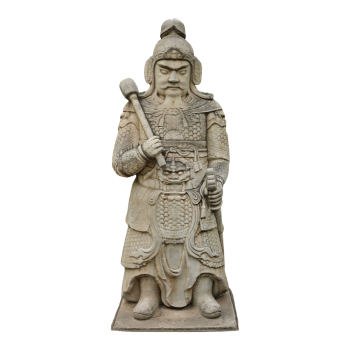
Since ancient times, China has been skilled in using bamboo strips to enrich and express depth and vitality through the interaction of "facial" bamboo strips. In traditional Chinese Han stone carving, this characteristic is most vividly reflected in the mid Qing Dynasty. Taking the stone lion with the inscription "Respected to Emperor Du Youzhang of the Qing Dynasty in the 14th year of the Jiaqing reign" as an example, its cheeks, nose wings, arms, shoulders, and limb trunks can all be seen with "tassels" dividing them, creating a turning point in the moving surface. The ribbon at the foot is also cut at the contour tassel, forming a bright and vigorous face, and conveying the layered and thick body feeling of the ribbon flipping. This pair of stone lions were punished for violating regulations by carving the female lion into an opening due to the craftsman's carelessness, resulting in no salary.
The Double Phoenix Jade Pendant from the Zhou Dynasty

The Double Phoenix Jade Pendant from the Zhou Dynasty

This jade pendant is from Tomb 60 of Liuli Ri in Hui County, Henan Province, and was buried together with the deceased. This light green jade piece is in the shape of two phoenixes, with a circular overall shape. The hollow carving imitates the shape and decoration of the work. The two sides of the pendant rotate upwards to form the head of a phoenix, while their circular bodies are connected to each other. A carved line surrounds the edge of the decoration, outlining the shape of a phoenix, while the entire piece is filled with curled cloud patterns. The pattern on the back of the pendant does not match its shape, indicating that the pendant was remade from an old piece of jade and is now housed in the National Museum of China.
Porcelain bowl with copper edge inlaid with blue and white porcelain from the Qianlong period of the Qing Dynasty

Porcelain bowl with copper edge inlaid with blue and white porcelain from the Qianlong period of the Qing Dynasty

The blue and white porcelain bowls made during the Qianlong period of the Qing Dynasty are now preserved in the Hunt Museum in England. The outer edge of the bowl is decorated with a Pegasus frame,
Song Chai Kiln Dark Lotus Pattern Bowl

Song Chai Kiln Dark Lotus Pattern Bowl

Chai Kiln was the imperial kiln of Zhou Shizong Chai Rong, the emperor of the Five Dynasties and Ten Kingdoms. According to records, the Chai kiln was established in the early years of Xiande in the Later Zhou Dynasty of the Five Dynasties. The porcelain produced by the Chai kiln is "as green as the sky, as clear as a mirror, as thin as paper, as loud as a bell, moist and delicate with fine lines." The exquisite craftsmanship is unparalleled, and it is the best among many kilns at that time.
Wooden Statue of Queen Mother of the Southern Song Dynasty

Wooden Statue of Queen Mother of the Southern Song Dynasty

The Queen Mother of the West is the supreme goddess of Taoism. After the establishment of Taoism, Queen Mother of the West was incorporated into the pantheon and became the supreme goddess of Taoism. Commonly known as the 'Queen Mother of the West' among the people. The title of "Queen Mother of the West" first appeared in the "Classic of Mountains and Seas". It is called "Queen Mother of the West" because her residence on Kunlun Hill in Hanzhong was originally from the west. The birthday of Queen Mother of the West falls on the third day of the third lunar month.
Shang Siyang Bronze Square Zun

Shang Siyang Bronze Square Zun

The Shang Siyang Bronze Square Zun is a bronze ritual vessel and sacrificial item from the late Shang Dynasty. Unearthed in 1938 on the mountainside of Zhuanerlun, Yueshanpu, Huangcai Town, Ningxiang County, Hunan Province (Tanheli Site), it is now collected in the National Museum of China. The Shang Siyang Bronze Square Zun is the largest existing bronze square Zun from the Shang Dynasty in China, with a side length of 52.4 centimeters, a height of 58.3 centimeters, and a weight of 34.5 kilograms. The entire object of the Shang Siyang Bronze Square Zun was cast using block casting method, which was seamless and exquisite, demonstrating superb casting skills. It is known as the "ultimate bronze model" in the field of history and is listed as one of the top ten national treasures passed down in China.
Ming and Qing blue and white plum vase

Ming and Qing blue and white plum vase

Meiping is a traditional famous porcelain. Meiping is a type of bottle with a small mouth, short neck, ample shoulders, thin bottom, and round feet. It is named after its small mouth that allows only plum branches to be inserted. Due to its slender body, it was called the "Jingping" during the Song Dynasty. It was used as a vessel for holding wine and had a sleek and beautiful shape. After the Ming Dynasty, it was called the "Meiping".
Jingde Blue and White Porcelain Vase from the Kangxi period of the Qing Dynasty

Jingde Blue and White Porcelain Vase from the Kangxi period of the Qing Dynasty

This Chinese cultural relic is a blue and white porcelain trumpet shaped vase fired in Jingdezhen during the Kangxi reign of the Qing Dynasty. The vase is decorated with fresh flowers and leaves, measuring 11cm in height, 11cm in width, and 11cm in length. It is currently housed in the Hunt Museum in the United Kingdom.
Qing Dynasty blue and white landscape painting incense burner

Qing Dynasty blue and white landscape painting incense burner

Blue and white porcelain is the most rich variety of porcelain with Eastern ethnic customs. It originated in the Tang Dynasty and matured in the Yuan Dynasty, mainly for export porcelain. Since the Ming Dynasty, it has become the mainstream of Chinese porcelain production. By the Qing Dynasty, blue and white porcelain still held a dominant position, serving the imperial family, popularizing among the people, and spreading far and wide to the world. It reached another historical peak in terms of craftsmanship, painting skills, and production.
Ming Yongle Blue and White Moon Embracing Vase

Ming Yongle Blue and White Moon Embracing Vase

The moon hugging bottle is a type of porcelain from the Qing Dynasty. Also known as the "Treasure Moon Bottle". Small mouth, straight neck, two ears on the neck side, named after the round moon like belly of the bottle. The appearance originated from the pottery horse hanging bottle popular in the Western Xia during the Song and Yuan dynasties, with a double series on the left and right sides, used to hang on the side of the saddle, which is highly ethnic. One of the common artifacts in the Yongle and Xuande Jingdezhen kilns of the Ming Dynasty, fired during the early period of Yongzheng and later discontinued. During the reign of Emperor Qianlong, there was also firing, mostly in blue and white.
The Painting of Emperor and Empress Worshiping Buddha in Longmen Grottoes

The Painting of Emperor and Empress Worshiping Buddha in Longmen Grottoes

The "Emperor and Empress Dowager Worship to Buddha" sculpture depicts the procession of offerings from Emperor Xiaowen and Empress Wenzhao of Northern Wei. The "Emperor and Empress Worship to Buddha" is a relief on the east wall of the Binyang Middle Cave in Longmen Grottoes. It was created during the Northern Wei Dynasty and is an important work of ancient Chinese relief sculpture, which was later stolen and sold abroad. The "Northern Wei Emperor Xiaowen's Worship to Buddha" painting is currently housed in the Museum of Art in New York City, USA, while the "Empress Wen Zhao's Worship to Buddha" painting is housed in the Nelson Museum of Art in Kansas City, USA.
Yuanlongquan Kiln Blue Glazed Brown Colored Plum Vase, Collection of Shenzhen Museum

Yuanlongquan Kiln Blue Glazed Brown Colored Plum Vase, Collection of Shenzhen Museum

The bottle body is exquisite, with a small mouth, short neck, ample shoulders, gradually converging from the belly to the bottom, and shallow circular feet. The bottle seat has round lips and flat folds, with three small holes on the neck. The seat body has three floral window shaped voids, and four small feet are placed at the bottom of the seat. The bottle body and bottle holder can be moved for loading and unloading. The continuous seated plum vase first appeared in the Song Dynasty and is one of the bottle styles that were first burned in the Song Dynasty. During the Yuan Dynasty, plum wine bottles had wider shoulders and fuller shapes, which were not as slender as those of the Song Dynasty. They were often used as wine vessels. The body of the connected plum vase is thick and fine, with a green glaze throughout the body. The glaze color is blue with a yellowish tint, and there are ice cracks on the glaze surface.
Ming Yongle Blue and White Cloud Dragon Pattern Tianqiu Vase, Hidden in the Palace Museum

Ming Yongle Blue and White Cloud Dragon Pattern Tianqiu Vase, Hidden in the Palace Museum

This cultural relic is 41.5 centimeters high, with a diameter of 9.3 centimeters and a foot diameter of 15.5 centimeters. The old collection of the Qing Palace. This vessel has a large and upright body, a round mouth, a straight neck, a mouth that is about the same size as the neck, a round belly, and shoulders that are about the same size as the bottom. It is commonly known as the "Heavenly Ball Bottle". The whole body is decorated with blue and white patterns, which are divided into two layers from top to bottom. The outer mouth is decorated with honeysuckle patterns, with branches and leaves as the skeleton, extending left and right to form a continuous edge decoration, and the neck is decorated with 6 cloud patterns. The entire abdomen is painted with cloud dragon patterns. The dragon has a large body, opens its mouth with angry eyes, and its mane rushes upwards, forming a back looking posture. Its limbs are extended forward, and its three claws are agile and powerful. Various shapes of cloud patterns are decorated in the gaps between the dragon bodies, highlighting the soaring momentum of the giant dragon. Flat bottomed white glaze without style.
Da Bu Huang Qian Bu Coin (Ancient Currency)

Da Bu Huang Qian Bu Coin (Ancient Currency)

After Wang Mang usurped power in the late Western Han Dynasty, coins were minted instead. In addition to using the square hole round coins from the Han Dynasty, he also ordered the casting of a batch of cloth coins. Da Bu Huang Qian is one of them, which is now rare. Xinmang currency has delicate inscriptions, exquisite craftsmanship, and multiple versions. The general Qian script is mainly composed of hanging needle seal script. This large yellow thousand cloth coin has a flat head, flat shoulders, and flat feet, with a slightly tapered waist. Drill a hole at the head for tying with a rope. Both sides of the front and back are cast as non piercing (i.e. there is no midline between the round piercing and the front end). Qian Wen is read on the right, arranged on both sides of the center line, evenly and appropriately, with smooth strokes.
chimes

chimes

The large percussion instrument of the Han ethnic group in ancient China, the chime bell, originated in the Zhou Dynasty and flourished during the Spring and Autumn Period and Warring States Period until the Qin and Han Dynasties. China was the earliest country to manufacture and use musical clocks. It is made of bronze and arranged in order of pitch by flat round clocks of different sizes. It is hung on a huge clock stand and struck with T-shaped wooden hammers and long rods, which can produce different musical sounds. Because each clock has a different pitch, striking according to the music spectrum can play beautiful music. Hang a set of copper bells with different tones on a wooden frame, and have the maid strike and play music with a small wooden mallet.
White pottery beast face pattern xun in the late Shang Dynasty

White pottery beast face pattern xun in the late Shang Dynasty

White pottery refers to a type of plain pottery with a white surface, interior, and texture.. White pottery has been found in the late Longshan Culture and early Erlitou Culture sites in western Henan province. Xun is a wind instrument that originated in the Neolithic Age (over 5000 years ago) and was initially used to transmit signals to each other; Or imitating bird calls as an auxiliary tool for catching.
Han Dynasty's "one knife equals five thousand" coin

Han Dynasty's "one knife equals five thousand" coin

This exhibit is a metal artifact from the Han Dynasty, commonly known as the Golden Cuo Knife. Each piece is worth five baht and five thousand pieces. It was minted during Wang Mang's first currency reform. It is currently housed in the Zhengzhou Museum.
Northern Song Ru kiln celadon lotus style warm bowl

Northern Song Ru kiln celadon lotus style warm bowl

The lotus shaped warm bowl from the Ru kiln of the Northern Song Dynasty was used to produce porcelain. The original vessel should be paired with a holding pot and was commonly used for warming wine during the late Tang and Song dynasties. Currently housed in the National Palace Museum in Taipei. Ru kiln was once used in the palace, but due to the method of covering and firing, the mouth had defects. Therefore, there was a move to "order Ruzhou to burn celadon in the palace". The selection of Ru kiln and the use of fully glazed support should be one of the reasons.
17th century Polish porcelain "Pear shaped Flower Coffee Pot"

17th century Polish porcelain "Pear shaped Flower Coffee Pot"

This porcelain pot is collected in the Royal Museum of Vail. The handle of the pot is shaped like the letter "J", with volutes on the top and bottom, and raised leaves and palms on the outside. The pot has a dome cap with a collar. The painting style includes randomly arranged flowers and realistic insects, with shadows painted in gray. This type of decoration became popular in the 1730s and was the first typical European porcelain painting style. The designs of flowers, fruits, and insects are taken from plant patterns.
"Terra Cotta Warriors and Horses and Troops"

"Terra Cotta Warriors and Horses and Troops"

The Terra Cotta Warriors, namely the Terra Cotta Warriors in the the Mausoleum of the First Qin Emperor, also referred to as the Terra Cotta Warriors or the Terracotta Warriors, are among the first batch of national key cultural relics protection units and the first batch of Chinese world heritage sites. A charioteer refers to a soldier on a chariot, excluding the rider and driver. There are usually two soldiers on a chariot, namely the left chariot figurine and the right chariot figurine. The figurine on the left side of the carriage is dressed in a long robe, covered in armor, with leg guards on the shin and a crossbeam on the head. It holds weapons such as spears, spears, and halberds in its left hand, and presses the carriage in its right hand. The attire of the figurine on the right side of the car is the same as that of the figurine on the left side, but the posture is opposite. They are both the main force of tank warfare, but according to literature records, they have certain differences in weapon configuration and combat responsibilities.
Porcelain "Imperial Yellow Glazed Porcelain Bowl" from the Qianlong period of the Qing Dynasty

Porcelain "Imperial Yellow Glazed Porcelain Bowl" from the Qianlong period of the Qing Dynasty

Yellow glazed porcelain is the most royal style artwork. Since the Han Dynasty, official kilns throughout history have fired yellow porcelain, but before the Ming Dynasty, yellow glazed porcelain did not show true yellow color, but rather yellow brown or dark yellow. Until the Hongzhi period of the Ming Dynasty, the firing of yellow porcelain truly reached its peak, and because the yellow glaze was pure, it was also known as "chicken oil yellow" by later generations. For feudal rulers, yellow was associated with wealth and auspiciousness, gradually transforming into a color used by the royal family and becoming a symbol of power and nobility.
Jingdezhen Blue and White Porcelain Vase "from the Kangxi period of the Qing Dynasty

Jingdezhen Blue and White Porcelain Vase "from the Kangxi period of the Qing Dynasty

This Chinese cultural relic is a porcelain vase from the Kangxi period of the Qing Dynasty (1662-1722). The vase is made of transparent and colorless underglaze blue and white porcelain with cobalt pigment, fired in Jingdezhen, and is now collected in the Smithsonian Museum.
Terracotta Warriors and Horses of the Qin Dynasty

Terracotta Warriors and Horses of the Qin Dynasty

In terms of identity, it is lower than the general figurine and can be classified as intermediate or lower level. The number of Qin terracotta warriors in the pit is extremely small, with less than ten unearthed, divided into two categories: the warrior robe general terracotta warriors and the armored general terracotta warriors. The armored general figurine appears to have a double or single crown on its head, and there are several different forms of armor worn. The terracotta warriors in battle robes are dressed in plain attire, but have floral knots on their chests. The front, back, and shoulders of the armored terracotta warriors are adorned with eight colorful floral knots, which are gorgeous, colorful, and elegant, highlighting their rank, identity, and majesty in the military.
Painted Porcelain Water Buffalo by Jacobs Adrien Halder

Painted Porcelain Water Buffalo by Jacobs Adrien Halder

Stone Carving of the Northern Wei Vows Buddha Pagoda during the Northern Wei Dynasty in the 4th Century

Stone Carving of the Northern Wei Vows Buddha Pagoda during the Northern Wei Dynasty in the 4th Century

This Buddhist scripture pillar engraved with sacred Buddhist scriptures belongs to a group of miniature pagodas (scenic pagodas), which are only found in the Gansu Corridor in northwest China. Their age ranges from 426 AD to 36 AD, some of which bear the names of Buddhist donors who entrusted them at home. A pagoda is a circular building built to worship Buddhist relics. Miniature pagodas may be commemorating visits to holy sites or representing donations to religious groups and sites.
Japanese Heian period woodcarving 'Shintoism'

Japanese Heian period woodcarving 'Shintoism'

God is the name of a deity related to the traditional Shinto religion in Japan. It is said that they were originally created for the Usa Hachiman Shrine in Oita, Kyushu. The Usa Hachiman Shrine has four main deities: Himeji Daisen, who helps those engaged in agriculture and sea travel; The legendary Emperor Chongjun of the 5th century was deified as the Divine Hachiman; Empress Jin Gu; And the deity of Kawahara Mountain who helped copper miners. The identities of these two characters are not yet clear, but they belong to a larger group that includes at least three other deities. The wooden carvings were first collected at the Cleveland Museum of Art.
Buddhist Ksitigarbha Bodhisattva clay sculpture

Buddhist Ksitigarbha Bodhisattva clay sculpture

Ksitigarbha Bodhisattva, a Buddhist bodhisattva name, is a transliteration of the Sanskrit K ṣ itigarbha, transliterated as "Qichadi Lianpo". In the Ten Wheel Sutra of Ksitigarbha, it is said that Ksitigarbha Bodhisattva is "as calm and composed as the earth, and as deep and secret as a secret treasure, hence its name. Ksitigarbha Bodhisattva is an important Bodhisattva in Buddhist tradition, revered as the savior and protector of sentient beings. His full name is Ksitigarbha Bodhisattva, also known as Ksitigarbha Bodhisattva King or Ksitigarbha Bodhisattva King. He is considered the ruler of hell, with the mission of protecting sentient beings and saving the souls. With infinite compassion and wisdom, Ksitigarbha Bodhisattva promises not to retreat from the suffering of sentient beings until they are all liberated from the cycle of suffering.
Marble Lotus Terrace Buddha statue

Marble Lotus Terrace Buddha statue

Lotus Terrace Thousand Hand Guanyin Stone Carving Sculpture

Lotus Terrace Thousand Hand Guanyin Stone Carving Sculpture

Mona Lisa "Mona Lisa" Mona Lisa portrait gold basket hanging painting

Mona Lisa "Mona Lisa" Mona Lisa portrait gold basket hanging painting

The Mona Lisa is an oil painting created by Italian Renaissance painter Leonardo da Vinci and is currently housed in the Louvre Museum in France. This painting mainly depicts the typical image of elegance and tranquility of women, shaping the image of a woman from the urban bourgeoisie during the rise of capitalism.
Bronze Pegasus Collected by Minneapolis Institute of the Arts

Bronze Pegasus Collected by Minneapolis Institute of the Arts

When the envoy sent to Central Asia returned to the court, he was amazed by this unique "heavenly horse". This robust animal has a strong back and shoulders, and works very hard, sweating profusely. Emperor Wu of China (141-87 BC) was fascinated by these stories and sent diplomats and later an army to obtain these horses. His interest in these extraordinary horses, as well as the increasingly important role of horses in military operations, largely indicates the popularity of horses in art since the Han Dynasty, especially during the rule of the Wu Kingdom. Bronze horses like this are placed in exquisitely decorated noble tombs.
Bronze square cauldrons from the early Western Zhou Dynasty collected by the Minneapolis Institute of Art

Bronze square cauldrons from the early Western Zhou Dynasty collected by the Minneapolis Institute of Art

Ding is a utensil used by ancient Chinese people in some places to cook and store meat, and is one of the most important bronze ware species in ancient times. The "ding" (cooking vessel) is considered by later generations to be the most representative of supreme power among all bronze vessels.
Making pottery from the Song Dynasty

Making pottery from the Song Dynasty

This is a pottery tile from Shitatou, Hangzhou City, Zhejiang Province, China, made around the Song Dynasty. Wadang refers to the front end of the cylindrical tile covering the eaves of ancient Chinese architecture; The entire tile at the front end of the eaves can also be called a tile, with a patterned hanging circular stopper on the tile surface. This tile is now located in the Komata Museum at the University of Tokyo in Japan.
Bronze Tripod of Early Western Zhou Dynasty Collected by Minneapolis Academy of Arts

Bronze Tripod of Early Western Zhou Dynasty Collected by Minneapolis Academy of Arts

Korean Goryeo period celadon teapot

Korean Goryeo period celadon teapot

A celadon teapot from the Goryeo period in Korea (918-1392), made around 1100 AD. The outer diameter of this celadon is 7.2 centimeters, and the overall height is 4.2 centimeters. This celadon is engraved with a scroll design, and many celadon ceramics have been repaired with gold paint. In Japan, this repair method is called "Jinji" (meaning "gold bonding"), which uses a mixture of shiny gold powder and paint to repair damaged parts. This teapot is currently housed in the Cleveland Museum of Art.