The tetradrachma silver coin, a currency from the classical period of ancient Greece

The tetradrachma silver coin, a currency from the classical period of ancient Greece

The obverse of this coin features the portrait of a young Hercules wearing a lion skin helmet. Hercules is a hero in Greek mythology known for his strength and courage. On this coin, he is depicted as a young man wearing lion skin, which is his emblem. Coins are made of silver. In ancient times, the tetradrachma was the most commonly used large denomination coin, usually made of silver. The weight of the coin is about 17 grams and the diameter is about 24 millimeters.
Commemorative Medal for the Opening of Jubilee Kindergarten during the Austrian Empire in the 20th Century

Commemorative Medal for the Opening of Jubilee Kindergarten during the Austrian Empire in the 20th Century

The plaque of Emperor Franz Joseph Jubilee's kindergarten opening. On the front is a scene of a kindergarten teacher and four children, with Emperor Franz Joseph presenting a bouquet of flowers. Franz Joseph Jubilee Emperor Kindergarten. On the back, five children gather around a sitting Christ, with a view of Leitz in the background. First collected in the State Museum of Lower Austria.
The Solidus gold coin issued by the Byzantine Empire in 641 AD

The Solidus gold coin issued by the Byzantine Empire in 641 AD

During the reign of Heraclius, the portrait of "Hekgram" and Jesus Christ from the reign of Justinian II appeared on coins. At first, attempts to use the portrait of Christ on coinage did not last until the latter half of the 9th century, when the images of Jesus Christ and subsequently the Virgin Mary became more common. By the end of the 10th century, Byzantium had produced a series of unnamed bronze coins and new Ginomismas, which lasted for a long time. In the late period, Byzantine coins gradually deteriorated in terms of metal composition and style, to the point where extremely rough coins of Emperor John VIII Palaiologogus appeared.
The Solidus gold coin issued by the Byzantine Empire in 610 AD

The Solidus gold coin issued by the Byzantine Empire in 610 AD

During the reign of Heraclius, the portrait of "Hekgram" and Jesus Christ from the reign of Justinian II appeared on coins. At first, attempts to use the portrait of Christ on coinage did not last until the latter half of the 9th century, when the images of Jesus Christ and subsequently the Virgin Mary became more common. By the end of the 10th century, Byzantium had produced a series of unnamed bronze coins and new Ginomismas, which lasted for a long time. In the late period, Byzantine coins gradually deteriorated in terms of metal composition and style, to the point where extremely rough coins of Emperor John VIII Palaiologogus appeared.
The Solidus gold coin issued by the Byzantine Empire in 582 AD

The Solidus gold coin issued by the Byzantine Empire in 582 AD

During the reign of Heraclius, the portrait of "Hekgram" and Jesus Christ from the reign of Justinian II appeared on coins. At first, attempts to use the portrait of Christ on coinage did not last until the latter half of the 9th century, when the images of Jesus Christ and subsequently the Virgin Mary became more common. By the end of the 10th century, Byzantium had produced a series of unnamed bronze coins and new Ginomismas, which lasted for a long time. In the late period, Byzantine coins gradually deteriorated in terms of metal composition and style, to the point where extremely rough coins of Emperor John VIII Palaiologogus appeared.
The Solidus gold coin issued by the Byzantine Empire in 535 AD

The Solidus gold coin issued by the Byzantine Empire in 535 AD

During the reign of Heraclius, the portrait of "Hekgram" and Jesus Christ from the reign of Justinian II appeared on coins. At first, attempts to use the portrait of Christ on coinage did not last until the latter half of the 9th century, when the images of Jesus Christ and subsequently the Virgin Mary became more common. By the end of the 10th century, Byzantium had produced a series of unnamed bronze coins and new Ginomismas, which lasted for a long time. In the late period, Byzantine coins gradually deteriorated in terms of metal composition and style, to the point where extremely rough coins of Emperor John VIII Palaiologogus appeared.
The Solidus gold coin issued by the Byzantine Empire in 565 AD

The Solidus gold coin issued by the Byzantine Empire in 565 AD

During the reign of Heraclius, the portrait of "Hekgram" and Jesus Christ from the reign of Justinian II appeared on coins. At first, attempts to use the portrait of Christ on coinage did not last until the latter half of the 9th century, when the images of Jesus Christ and subsequently the Virgin Mary became more common. By the end of the 10th century, Byzantium had produced a series of unnamed bronze coins and new Ginomismas, which lasted for a long time. In the late period, Byzantine coins gradually deteriorated in terms of metal composition and style, to the point where extremely rough coins of Emperor John VIII Palaiologogus appeared.
The Solidus gold coin issued by the Byzantine Empire in 527 AD

The Solidus gold coin issued by the Byzantine Empire in 527 AD

During the reign of Heraclius, the portrait of "Hekgram" and Jesus Christ from the reign of Justinian II appeared on coins. At first, attempts to use the portrait of Christ on coinage did not last until the latter half of the 9th century, when the images of Jesus Christ and subsequently the Virgin Mary became more common. By the end of the 10th century, Byzantium had produced a series of unnamed bronze coins and new Ginomismas, which lasted for a long time. In the late period, Byzantine coins gradually deteriorated in terms of metal composition and style, to the point where extremely rough coins of Emperor John VIII Palaiologogus appeared.
The Solidus gold coin issued by the Byzantine Empire in 498 AD

The Solidus gold coin issued by the Byzantine Empire in 498 AD

During the reign of Heraclius, the portrait of "Hekgram" and Jesus Christ from the reign of Justinian II appeared on coins. At first, attempts to use the portrait of Christ on coinage did not last until the latter half of the 9th century, when the images of Jesus Christ and subsequently the Virgin Mary became more common. By the end of the 10th century, Byzantium had produced a series of unnamed bronze coins and new Ginomismas, which lasted for a long time. In the late period, Byzantine coins gradually deteriorated in terms of metal composition and style, to the point where extremely rough coins of Emperor John VIII Palaiologogus appeared.
During the Qianlong period of the Qing Dynasty, the currency was Qianlong Tongbao copper coins
During the Qianlong period of the Qing Dynasty, the currency was Qianlong Tongbao copper coins

Qianlong Tongbao is a copper coin minted during the reign of Emperor Qianlong of the Qing Dynasty (1736-1795). The Manchu script on the back is quite complex. You can refer to Huaguangpu's "Catalogue of Ancient Chinese Coins", which provides detailed prices and coin rubbings. The production bureaus of Qianlong Tongbao include 20 bureaus such as Baoquan, Baoyuan, Baozhi, and Baozhe, with materials including brass, bronze, and red copper. The Qianlong Tongbao coin is written in Manchu as "Qianlong Tongbao", with a value of "one", meaning auspicious. This coin has a small face value, a small circulation range, fine and even strokes, and smooth writing.
Commemorative Medal of the Austrian Republic in the 20th Century: Honorary Citizen Medal

Commemorative Medal of the Austrian Republic in the 20th Century: Honorary Citizen Medal

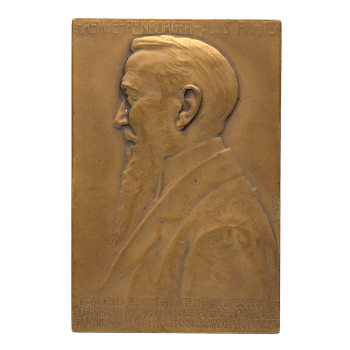
The plaque of Alois Richter Honorary Citizen. On the front is a side image of Alois Richter. On the back is a stylized eagle, depicted in the full body of two boys, facing each other, holding hands, with a vine wreath behind it. The emblem of Leitz Town is located in the lower left corner, while the emblem of the Alliance of Krems is located in the lower right corner. Danube in front of the flower belt. Medal winner: Arnold Hatig. Bronze; 7,6 x 5 centimeters; Around 1910. Alois Richter (1849-1919) was a numismatist and the mayor of Leitz.
Commemorative Medal of the Republic of Austria in the 20th Century: "Herzogenburg City Upgrading Commemorative Medal"
Commemorative Medal of the Republic of Austria in the 20th Century: "Herzogenburg City Upgrading Commemorative Medal"

This medal was made to celebrate the 1927 exhibition in the city of Herzog. On the front, there is a view of the monastery and the college church, the emblem of the alliance, oak leaves, grapevines, and the words "EXEHIBITION HERZOGENBURG STADTERHEBUNG 1927" written on it, which means "Exhibition 1927 in Herzogenburg City". In the foreground on the back, a farmer and a blacksmith are in front of a plow, with a town and monastery in the background. It says' FOR EXCELLENT PERFORMING ', which means' excellent performance'.
17th century Austrian Holy Roman Empire Medal "Half body of Johann Battista Werda"
17th century Austrian Holy Roman Empire Medal "Half body of Johann Battista Werda"

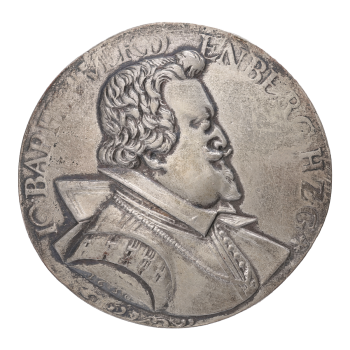
This medal was made for John Baptiste Verda, Count of Verdenberg. This medal is replicated through electroplating, lead casting, welding, and silver plating. The front displays a bust of the Count with the words "IO: BAP: FHV. VERDENBERGH: ZG 1630" written on it. On the back, a snake ring surrounds a hexagonal star, suspended above a patch of grass. It is currently housed in the State Museum of Lower Austria.
The commemorative medal of the Austrian Empire in the 20th century, the Vienna Baden Medal of Honor

The commemorative medal of the Austrian Empire in the 20th century, the Vienna Baden Medal of Honor

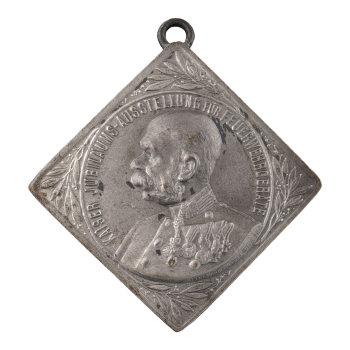
This medal was awarded to celebrate the Royal Fire Equipment Exhibition held in Baden near Vienna in September 1908. On the front is a half body portrait of the emperor and laurel leaves, with the words "IMPERIAL JUBILEE EXEHIBITION FOR FIRE-FIGHTING EQUIPMENT" written on it, which is the "Royal Fire Equipment Exhibition Commemorative Exhibition". On the back are the emblem of Baden and oak leaves. The medal is made by Reinemer&Spiegel and measures 4.45 x 4 centimeters. It is made of copper nickel zinc alloy.
During the period from the Northern Song Dynasty to the Dao Dynasty, the currency was represented by Dao Yuanbao copper coins

During the period from the Northern Song Dynasty to the Dao Dynasty, the currency was represented by Dao Yuanbao copper coins

Zhidao Yuanbao "is a currency minted by Emperor Taizong of Song, Zhao Guangyi, in the first year of Zhidao (995 AD). The diameter of this coin is about 2.5 centimeters and its weight is about 3.8 grams. Qian Wen has three types of writing styles: regular script, running script, and cursive script. It is said to have been handwritten by Emperor Taizong of Song, Zhao Guangyi, and is known as the "Imperial Script". Zhidao Yuanbao held an important position in the ancient currency system. As a currency of the Song Dynasty, Zhidao Yuanbao played an important role in circulation. At the same time, the casting and circulation of Zhidao Yuanbao also reflected the economic prosperity and social stability of the Song Dynasty.
During the Xuanhe period of the Northern Song Dynasty, the currency was Xuanhe Tongbao copper coins
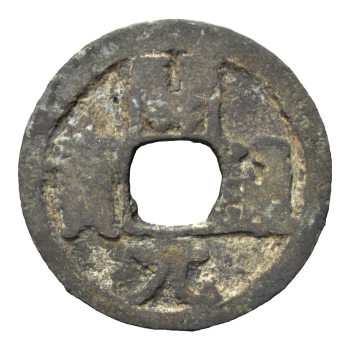
During the Xuanhe period of the Northern Song Dynasty, the currency was Xuanhe Tongbao copper coins

Xuanhe Tongbao "is a year name coin minted by Emperor Huizong of Song, Zhao Ji, during the Xuanhe period (1119-1125 AD). Xuanhe Tongbao is a combination of seal script and clerical script for coins, with direct reading. The currency values include Xiaoping, Fen Er, Fen San, and Fen Wu, with differences in coin diameter. Xiaoping generally has a diameter of about 2.4 centimeters, Fen Er is about 2.7 centimeters, Fen San is about 2.9 to 3 centimeters, and Fen Wu has a diameter of about 3.2 centimeters. Emperor Huizong of Song personally inscribed the inscriptions "Chongning Tongbao", "Daguan Tongbao", and "Xuanhe Tongbao" with his unique "thin gold body". The fonts were dignified and beautiful, and the strokes were straight and handsome, earning him the nickname "iron strokes and silver hooks".
During the Wude period of the Tang Dynasty, the currency Kaiyuan Tongbao was used

During the Wude period of the Tang Dynasty, the currency Kaiyuan Tongbao was used

Kaiyuan Tongbao "is a currency minted on August 2, 621 AD, in the fourth year of Emperor Gaozu of Tang Dynasty's Wude reign. This is the longest and most important circulating currency of the Tang Dynasty. The top, bottom, right, and left characters on the coin face are read as' Kaiyuan Tongbao ', while the top, right, bottom, and left characters are read as' Kaiyuan Yuanbao'. Although "Kaiyuan" was a reign title of Emperor Xuanzong of Tang, "Kaiyuan Tongbao" was not a reign title coin, nor was it a currency that only began to be used during the reign of Emperor Xuanzong of Tang. The main reason why Tang Gaozu's reign title was named "Kaiyuan Tongbao" instead of "Wude Tongbao" was that there was no market for reign title coins at that time.
During the Daguan period of the Northern Song Dynasty, the currency was Daguan Tongbao copper coins

During the Daguan period of the Northern Song Dynasty, the currency was Daguan Tongbao copper coins

Daguan Tongbao "is a year name coin minted by Emperor Huizong Zhao Ji of the Northern Song Dynasty during the Daguan period (1107-1110 AD). It has various formats such as Xiaoping, Fold 2, Fold 3, Fold 10, etc. The currency of the Northern Song Dynasty, Daguan Tongbao, was inscribed with inscriptions by Emperor Huizong. The Song Dynasty was different from previous dynasties in that new coins were minted with each new year name. If the year name was the same as the Baowen, non year name coins were minted even more. In the third hundred years of the Song Dynasty, the main currency used was the small flat folded two coins, during which there were also large coins circulating and the outline and size of the coins had certain standards. Rare throughout history, in addition to the authentic, cursive, clerical, and seal scripts, Qian Wen also features the thin gold body of Emperor Huizong of the Northern Song Dynasty, known as the "Jade Carving Silver Hook".
The Talan copper coin of King Antiochus during the classical period of ancient Greece

The Talan copper coin of King Antiochus during the classical period of ancient Greece

King Antiochus was the king of the Indo Greek kingdom and ruled over the capital city of Taxila. Bopearachchi believed that he ruled in the western part of the Indo Greek kingdom from 115 BC to 95 BC, while R.C. Senior placed him around 130-120 BC and in the eastern part of Punjab. Dram (English: dram or drachm; pharmaceutical symbol: ʒ) was originally a weight and coin unit in ancient Greece. It is a unit of mass in the constant weight system, as well as a unit of mass and volume in the pharmaceutical weight system
Commemorative coin of Vienna Neustadt Beekeeping Association "Meritorious Medal of Vienna Neustadt Beekeeping Association" in Austria

Commemorative coin of Vienna Neustadt Beekeeping Association "Meritorious Medal of Vienna Neustadt Beekeeping Association" in Austria

The commemorative coin is the "Vienna Neustadt Beekeeping Association Meritorious Medal" designed by Kristelbauer/John Schwetner. The obverse of the commemorative coin features the emblem of Neustadt, Vienna, with the inscription "BEEKEEPING ASSOCIATION - WR. NEUSTADT". On the back of the commemorative coin, there are three circular medals depicting a beehive (top), Vienna Neustadt (bottom left), and the spinning woman of Vienna Neustadt (bottom right), surrounded by floral decorations with the inscription "THE MERIT". They are currently housed in the St. Peter's Abbey Museum.
A medieval lover's badge

A medieval lover's badge

This badge is a secular lover token, shaped like a crown heart with a slanted scroll. The scroll is inscribed with the medieval English word 'herte be trewe', meaning 'the heart must be true'.
Commemorative medal for the 600th anniversary of the founding of the city of K ö rnberg during the Austrian Empire in the 19th century

Commemorative medal for the 600th anniversary of the founding of the city of K ö rnberg during the Austrian Empire in the 19th century

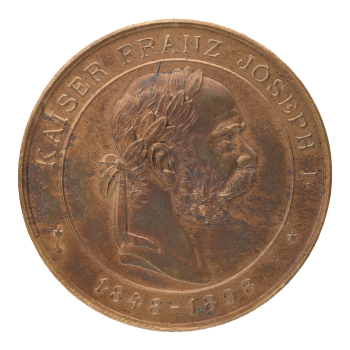
It was cast to celebrate the 600th anniversary of the founding of the city of K ö rnberg in Austria and the 50th anniversary of the reign of Franz Joseph I. The portrait on this commemorative coin is of Franz Joseph I on the side, with the inscription "EMPEROR FRANZ JOSEPH I. 1848-1898". The back of the commemorative coin displays the emblem of the city of K ö rnberg, with the inscription "MUNICIPALITY OF KORNEUBURG 1298-1898". This commemorative coin is made of bronze, with a diameter of 5 centimeters, and was minted in 1898.
Attica Standard Edition of Menander I Silver Coins from the Classical Period of Ancient Greece

Attica Standard Edition of Menander I Silver Coins from the Classical Period of Ancient Greece

The obverse depicts a silver coin of Menander I. Menander I was the king of ancient Greece Bactria and later India Greece. His ruling regions include Balkh Province in present-day Afghanistan, Khyber Pakhtunkhwa Province in India, and the Greater Punjab region. This silver coin is the Attica Standard Edition, and this style of silver coin is very rare, possibly only issued as a gift. The weight of this silver coin meets Attic standards, with only two denominations: gold and silver. The Harvard Art Museum has a collection of silver coins from Menander I.
The copper coin of Nande I, a currency of the classical period in ancient Greece

The copper coin of Nande I, a currency of the classical period in ancient Greece

The obverse depicts the copper coin of Menander I. Menander I was the king of ancient Greece Bactria and later India Greece. His ruling regions include Balkh Province in present-day Afghanistan, Khyber Pakhtunkhwa Province in India, and the Greater Punjab region. This style is the Athena Archidemus version, with the obverse depicting the portrait of Menander I and the reverse depicting Athena Archidemus standing on the left, holding a shield with her left hand and throwing thunder with her right hand. The Harvard Art Museum has a collection of Menander I's copper coins.
The currency of the ancient Greek classical period, the silver coin of Menander I

The currency of the ancient Greek classical period, the silver coin of Menander I

The obverse depicts a silver coin of Menander I. Menander I was the king of ancient Greece Bactria and later India Greece. His ruling regions include Balkh Province in present-day Afghanistan, Khyber Pakhtunkhwa Province in India, and the Greater Punjab region. This style is the Athena Alcides version, with the obverse depicting the portrait of Menander I and the reverse depicting Athena Alcides standing on the left, holding a shield with her left hand and throwing thunder with her right hand. The Harvard Art Museum has a collection of Menander I's silver coins.
The currency of ancient Greek classical period, Eucratide I Status copper coin

The currency of ancient Greek classical period, Eucratide I Status copper coin

This artifact is a Stat copper coin of Diobor with an Eucratic inscription. Eucratis was the last important king of Bactria in Greece in the mid-2nd century BC. He reigned from 170 BC to 145 BC, overthrew the Yutimid dynasty, and restored the rule of the Diodotid dynasty. This stele is collected by the British Museum.
Currency of the Kushan Empire, Weimar Taktu Copper Coin, 80 AD

Currency of the Kushan Empire, Weimar Taktu Copper Coin, 80 AD

Vima Tacto has long been known as the 'Nameless King' because his coins only display the legend of 'King of Kings, Great Savior', until the discovery of the Labatak inscription helped link his name with the title on the coins. This copper coin belongs to Sot Megas, also known as Emperor Weimar Taktu of the Kushan Empire, who reigned from 80 to 90 AD. This copper coin has a diameter of 20 millimeters and weighs 8.23 grams. It is currently housed in the British Museum.
Baden City Ascension Commemorative Medal - Frederick III

Baden City Ascension Commemorative Medal - Frederick III

This commemorative medal was made to celebrate the upgrading of Baden town to a city. The front of the commemorative medal features a half profile portrait of Frederick III, with the words' Emperor Frederick III 1440-1493 'written on it. On the back of the commemorative medal is the emblem of Baden and a grapevine, with the words' 1480 Baden 1930 elevation to a city 'written on it. The commemorative medal is made of bronze with a diameter of 6 centimeters. It was made in 1930 and is exhibited at the State Museum of Lower Austria in Austria.
The Michael H ö rlich Medal, a commemorative medal from the Austrian Empire in the 16th century

The Michael H ö rlich Medal, a commemorative medal from the Austrian Empire in the 16th century

This commemorative medal was made in honor of Michael Hurlich, the abbot of the Getweg Monastery. The front of the commemorative medal features a half profile portrait of Herlich, with the words' MICH Æ L HERRLICH A [B] BAS GOTVICENSIS Æ T LI 'written on it. On the back of the commemorative medal is the city emblem of Getweg Monastery, which reads "DEVS REFVGIVM MEXM A ᴼ 1590". The commemorative medal is made of silver with a diameter of 3.5 centimeters. It was made in 1590 and is exhibited at the State Museum of Lower Austria in Austria.
The Michael Haydn Medal, a commemorative medal from the Austrian Republic in the 20th century

The Michael Haydn Medal, a commemorative medal from the Austrian Republic in the 20th century
Michael Haydn was an Austrian composer of the modern era, and this commemorative medal was made in honor of Michael Haydn. The front of the commemorative medal features a half profile portrait of Haydn, with the words' MiCHAEL HAYDN: 1737-1806 'written on it. On the back of the commemorative medal is a scene of Hohenzollerbach, with two little angels on the left holding violins and a sheet music on the right. The commemorative medal is made of bronze with a diameter of 7.6 centimeters. It was made in 1927 and is exhibited at the State Museum of Lower Austria in Austria.
Commemorative medal of the Austrian Republic period in the 20th century, "Outstanding Medal of the Lower Austrian Agricultural Chamber of Commerce"
Commemorative medal of the Austrian Republic period in the 20th century, "Outstanding Medal of the Lower Austrian Agricultural Chamber of Commerce"

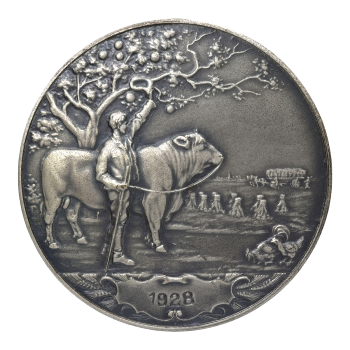
This commemorative medal is made to celebrate the outstanding performance of the Austrian Agricultural Chamber of Commerce. The front of the commemorative medal features a farmer and his cattle in front of an apple tree, with a harvest scene in the background. The back of the commemorative medal features the emblem of Lower Austria and five castles, while the front displays laurel leaves. It says' Progress. Lower Austrian Agricultural Chamber of Commerce. '. The commemorative medal is made of bronze, with a silver plated surface and a diameter of 5.5 centimeters. It was made in 1928. This commemorative medal is on display at the State Museum of Lower Austria in Austria.
Commemorative Medal of the Austrian Republic in the 20th Century, "Turn Meritorious Medal"

Commemorative Medal of the Austrian Republic in the 20th Century, "Turn Meritorious Medal"

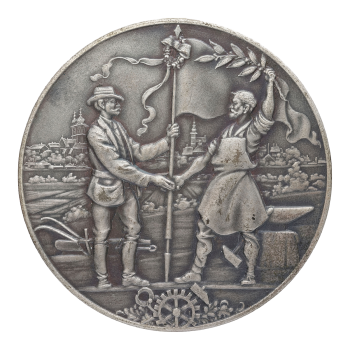
This commemorative medal was made to celebrate the Lower Austria Provincial Exhibition held in Thurn. The front of the commemorative medal features farmers and craftsmen facing each other, each holding a central flag with their right hand. The farmer's left hand is also on the flagpole, while the craftsman's left hand lifts a laurel branch. Under their feet are symbols of agriculture, trade, and engineering, and the background is a scene from Turen. The back of the commemorative medal features the city emblem of Turen and laurel leaves. This commemorative medal is on display at the State Museum of Lower Austria in Austria.
The commemorative medal of the Austrian Empire period in the 19th century, titled "Rudolf Crown Prince Tasting Reiz Gold Wine Commemorative Medal"
The commemorative medal of the Austrian Empire period in the 19th century, titled "Rudolf Crown Prince Tasting Reiz Gold Wine Commemorative Medal"

The front of the commemorative medal features a quarter profile portrait of Rudolf, with the words' ARCHDUKE RUDOLF CROWN PRINCE OF AUSTRA 'written on it. The back of the commemorative medal features a view of a tall cup with a lid and the city emblem of Leitz. The creator of the commemorative medal is Kristelbauer. The medal is made of bronze with a diameter of 5.4 centimeters and was made in 1888. It is collected in the State Museum of Lower Austria, Austria.
20th Century Austrian Empire Period Commemorative Medal "Kaiser Franz Joseph District Orphanage Commemorative Medal"
20th Century Austrian Empire Period Commemorative Medal "Kaiser Franz Joseph District Orphanage Commemorative Medal"

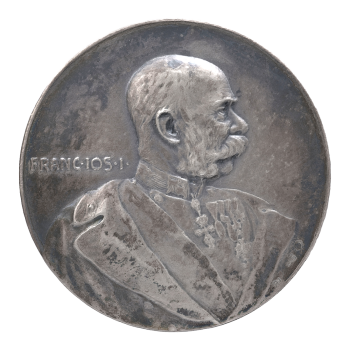
This commemorative medal was made to celebrate the establishment of the orphanage in Leitz. The obverse of the commemorative medal features a quarter profile portrait of Franz Joseph I, with the words "FRANC. IOS. I. Monogram RN. The back of the commemorative medal features the architectural view of the orphanage and the city emblem of Leitz. The commemorative medal is made of silver, with a diameter of 3.7 centimeters, and was made in 1905. Franz Joseph I, Emperor of Austria and Austria Hungary, was a ruler of central and southern Europe in the 19th and 20th centuries. This commemorative medal is on display at the State Museum of Lower Austria in Austria.
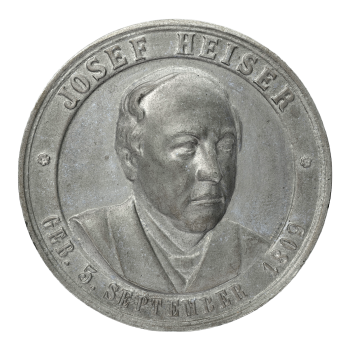
The Joseph Hesse 60th Anniversary Medal, a commemorative plaque for British entrepreneurs

The Joseph Hesse 60th Anniversary Medal, a commemorative plaque for British entrepreneurs

This commemorative medal was made to celebrate Joseph Heyser's 60th anniversary. The front of the commemorative medal features a half profile portrait of Heather, with the words' JOSEF HEISER. BORN. SEPTEMBER 3, 1809 'written on it. The back of the commemorative medal features Heather's patented shaft and laurel leaves, with the words' AUGUST 1828 AUGUST 1888 'written on it. The creator of the commemorative medal is Heinrich Yanauer. The medal is made of British metal, with a diameter of 5.2 centimeters, and was made in 1888.