
Animal shaped Decorative Ceramic Containers - Bonn Collection in the Americas

Animal shaped Decorative Ceramic Containers - Bonn Collection in the Americas

The container decorated with animal forms in the Bonn Collection of America is a uniquely shaped and colorful pottery. This container is spherical in shape, with multiple colored patterns of dark brown, beige, red earth, and green painted on the surface. It has two water outlets connected in the shape of stirrups and is decorated with two animal shaped sculptures. The main body displays a personified face, which is likely a symbol of the sun. This container may have originated from the Moche culture and was collected by Teddy Hahn. Not only is it a practical liquid dispenser, but it is also a masterpiece that blends art and culture.
Mammalian shaped stirrup pot - Bonn Collection, America

Mammalian shaped stirrup pot - Bonn Collection, America

In the Bonn American Collection, there is a mammalian shaped stirrup pot. The main design of this pot imitates the image of a lying, curled mammal, with a very large stirrup relative to the body and a long neck. The origin of this stirrup pot is not yet clear, it was collected by Teddy Hahn. The stirrup jar is an ancient pottery commonly used to hold liquids such as oil or wine, and its design and production techniques reflect the level of craftsmanship and aesthetic style of ancient civilization. It is not only a practical container, but also a work of art that embodies the creativity and skills of ancient craftsmen.
Relief Cup - American Bonn Collection Series

Relief Cup - American Bonn Collection Series

Collected in the Bonn Collection in the Americas, the surface is coated with delicate orange and features relief decorations. There are two opposing rectangular patterns on the outer side of the cup, which are similar in design and both depict a male image and a side view of a snake. In both patterns, men are wearing a variety of headpieces, waistbands, and different forms of chains. This cup comes from Carassia, El Salvador, and belongs to the Maya culture. It is one of the collections of Mera de Fernandez Shafer.
Cleveland Museum of Art Silver Horn

Cleveland Museum of Art Silver Horn

The silverware collected by the Cleveland Museum of Art, made in about 700 AD, is from Central Asia or Xizang and belongs to the early works of the eighth century. Made of silver and decorated with gold plating, presenting a magnificent appearance. Showcased the creator's exquisite craftsmanship and delicate skills. The specific purpose is still unknown, but they may have been used as decorations for religious ceremonies or aristocratic residences. The design and decoration of the utensils used complex geometry, animal and plant patterns and character images, which showed the cultural characteristics and artistic style of Central Asia or Xizang at that time. It is the Cleveland Museum of Art through J H. One of the important collectibles purchased by the Wade Fund.
Cleveland Museum of Art silverware - Cup

Cleveland Museum of Art silverware - Cup

The silverware collected by the Cleveland Museum of Art, made in about 700 AD, is from Central Asia or Xizang and belongs to the early works of the eighth century. Made of silver and decorated with gold plating, presenting a magnificent appearance. Showcased the creator's exquisite craftsmanship and delicate skills. The specific purpose is still unknown, but they may have been used as decorations for religious ceremonies or aristocratic residences. The design and decoration of the utensils used complex geometry, animal and plant patterns and character images, which showed the cultural characteristics and artistic style of Central Asia or Xizang at that time. It is the Cleveland Museum of Art through J H. One of the important collectibles purchased by the Wade Fund.
Austrian Baden Shooting Competition Commemorative Medal

Austrian Baden Shooting Competition Commemorative Medal

This badge was made to commemorate the 12th Lower Austrian Province Shooting Competition held in Baden, Austria. The badge depicts a shooter dressed in historic attire, holding a target and rifle. In the background, we can see the main facade of W ü rzburg Castle and the city emblem of Baden. There is a plaque on the back of the badge that reads' GG LINDNER M Ü NCHEN ', indicating the company that produced this badge. This badge is made of silver plated brass, 4.5 centimeters high, and was made in 1911.
Cleveland Museum of Art Silverware - Vase

Cleveland Museum of Art Silverware - Vase

The silverware collected by the Cleveland Museum of Art, made in about 700 AD, is from Central Asia or Xizang and belongs to the early works of the eighth century. Made of silver and decorated with gold plating, presenting a magnificent appearance. Showcased the creator's exquisite craftsmanship and delicate skills. The specific purpose is still unknown, but they may have been used as decorations for religious ceremonies or aristocratic residences. The design and decoration of the utensils used complex geometry, animal and plant patterns and character images, which showed the cultural characteristics and artistic style of Central Asia or Xizang at that time. It is the Cleveland Museum of Art through J H. One of the important collectibles purchased by the Wade Fund.
Scyphate Gold Bowl

Scyphate Gold Bowl

The gold bowl named Scyphate was created between 1059 and 1067, belonging to the Byzantine Empire period, which was Byzantine art in the 11th century. It is a shallow bowl commonly used for drinking alcohol or as a ceremonial utensil. With a diameter of 2.5 centimeters and made of pure gold, it showcases the exquisite metal craftsmanship and decorative art of the Byzantine period. Byzantine art is renowned for its ornate decorations, religious themes, and symbolism, and was used in religious ceremonies or court celebrations at the time. The design and production reflect the emphasis on refined living and religious beliefs in Byzantine culture. It is currently housed in the Cleveland Museum of Art.
Rax Mountain Bear Cave Association Commemorative Medal

Rax Mountain Bear Cave Association Commemorative Medal

This badge was created to celebrate the 15th anniversary of the Alpine Association's "Rax Mountain Bear Cave Association". There is a standing bear in the center of this circular badge. The back of the badge originally had a pin, but it has now been lost. The diameter of the badge is 4 centimeters.
Da Wei De Kong Mandala

Da Wei De Kong Mandala

The Dawei King Kong Mandala was created in 1991 by monks from the Gelug sect at the Minneapolis Museum of Art in the United States. This mandala is made of colored silicate and adhesive on wood. Mandala is a visual representation of the Buddhist universe, used for meditation and enlightenment rituals. The process of making mandalas takes four weeks and is sanctified through prayer, ritual music, and performance.
Pottery made by Chim ú culture

Pottery made by Chim ú culture

It is a pottery made by the Chim ú culture, dating back to the Intermedio Tard í o period, approximately between 200 and 600 AD. Chim ú culture is an important civilization in the history of the Andean region of South America, known for its exquisite metalworking and large-scale architectural works. The pottery art of this period demonstrated a high degree of technological and artistic achievement, reflecting the political division and cultural diversity of the society at that time. Not only is it a practical daily item, but it is also an important archaeological material for studying cultural and social structures, religious beliefs, and artistic styles.
Collins Bowl - Bonn University Academic Art Museum

Collins Bowl - Bonn University Academic Art Museum

The Corinthian bowl collected by the Academic Art Museum of the University of Bonn is an ancient Greek pottery dating back to around 575 BC, representing the pinnacle of pottery production during the Corinthian period. The excavation location of this bowl is unknown, but its exquisite craftsmanship and decoration showcase the superb skills of ancient Greek potters. The bowl wall is very thin, the bottom is low, the belly is spherical, the mouth edge is noticeably outward sloping, and there are handles installed horizontally on both sides. The bowl is adorned with a circular decorative strip, with two to three groups of warriors depicted on one side and riders galloping to the left on the other side. These patterns not only beautify pottery, but also reflect the wars, myths, and nature worship of ancient Greek society
Silver sacrificial bowl

Silver sacrificial bowl

This silver bowl was created by the famous silversmith Maung ShweYon from Myanmar. The bottom of the bowl is engraved with the silversmith's logo, a sitting deer in a 16 o'clock star, and the silversmith's initials' M. ' S.Y.'。 This bowl depicts ten scenes from Patachara's hard experience before becoming an outstanding Arhat and the main disciple of Buddha. Her story is included in "Therigatha," a collection of poems written around 1880 and currently housed in the Minneapolis Museum of Art
The "Candy Box" pottery made by Henry Amiro
The "Candy Box" pottery made by Henry Amiro

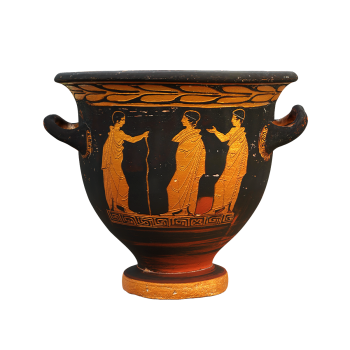
Henri Amiro was a French ceramic artist in the early 20th century, known for his exquisite mold making and decorative ceramics. The work 'Bonbonni è re' (candy box) is a typical representative of the early 20th century, showcasing his artistic style and techniques. It is one of the collections of the Parthenay Museum of Art and History in France. This piece was not glazed, which was very rare at the time. Amiro's work is not only a practical container, but also a sculptural artwork showcasing his artistic talent, reflecting the high level of French ceramic art in the early 20th century.
Attic Red Pottery Bottle - Bonn University Art Museum

Attic Red Pottery Bottle - Bonn University Art Museum

It is a masterpiece of ancient Greek pottery art, currently housed in the Bonn University Art Museum. Known for its unique shape and decorative style, it is characterized by patterns drawn with black or dark brown pigments on reddish brown clay, creating sharp contrasts. It usually has a wide mouth rim and a downward contracting neck, shaped like an inverted bell, hence the name "Bell Ceramic Bottle". In ancient Greece, it was widely used to mix water and wine, and was an indispensable container for banquets and social events. The patterns on the bottle usually depict mythological stories, daily life scenes, or animals, and these intricate paintings showcase the superb skills of ancient Greek artists.
Head shaped Bottle - American Bonn Collection

Head shaped Bottle - American Bonn Collection

The bottle in the shape of a human head belongs to the precious collection of the Bonn Collection in the Americas. Having an swollen spherical body and a slender neck, the neck is ingeniously shaped like a human head. The specific place of origin is not yet known, but this design undoubtedly reflects the imagination and artistry of ancient American civilization in pottery creation. A spherical body may symbolize abundance and vitality, while the shape of a head on the neck may have specific cultural or religious significance, perhaps as a commemoration of ancestors or a representation of mythological figures. As part of the Bonn American Collection, it provides us with important clues for studying ancient American culture and art.
Edward Noerplin's' The Flower Girl '

Edward Noerplin's' The Flower Girl '

This fine porcelain hand-painted flower vase designed by Edward Noerplin was created between 1902 and 1916 and produced in Parthenay, France. Known for its exquisite craftsmanship and color matching. The overall color is pink, with three decorative tubular nozzles at the top. Both sides are equipped with brown handles, and the center is decorated with a relief angel pattern on a white background. The bottom of the flower vase is hollowed out. There are currently two damages, one at the mouth and the other at the bottom. It is currently held in the collection of the Parthenay Museum of Art and History in France.
Ceramic flower pot designed by Henry Amiro
Ceramic flower pot designed by Henry Amiro

The ceramic flowerpot designed by Henry Amiro is a work from the late 19th century to the early 20th century, made of ceramics using Parthenay's fine molds. The feature is that the bottom of the pot is decorated with a sticker strip of sweet potato leaves, and the whole is covered with patterns of snails, lizards, butterflies, mythical animals, and vines. The edges of the flowerpot are thin and straight, decorated with black underglaze color. The colors are mainly dark blue and aquamarine, giving people a sense of tranquility and depth. The art and history museum currently located in Parthenay, France.
Jaguar shaped artifact

Jaguar shaped artifact

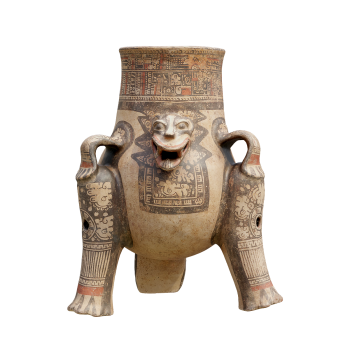
It is an ancient Costa Rican artwork dating back to approximately 1100 to 1200 AD, currently housed in the Minneapolis Museum of Art. This artifact is one of the classic ancient Costa Rican art forms, whose shape imitates a feline god that devours the sun. The surface is covered with rich and colorful painted patterns, which not only refer to leopards, but also involve celestial elements such as the sun and stars. The legs of these objects are usually hollow, with clay balls placed inside to make sound.
Khmer Civilization Container

Khmer Civilization Container

It is an ancient Khmer civilization pottery from the 1st century BC, currently housed in the Minneapolis Museum of Art. This container is a representative of Khmer art and craftsmanship, reflecting the achievements of Khmer culture in pottery making technology at that time. The shape, decoration, and materials of the container may reveal the social customs, religious beliefs, and aesthetic tendencies of the time.
Nazca Cultural Container

Nazca Cultural Container

It is a pottery item in the Bonn American Collection series. This container has a spherical bottom and an S-shaped side profile. It is a colorful painted pottery with a face image painted on it. This container originates from Peru and belongs to the Nazca culture. In 1975, it entered H. as a donation gift Senff's collection. The Nazca culture is renowned for its exquisite pottery and textiles, which not only showcase the daily lives of the Nazca people but also reflect their religious beliefs and worldview. As a representative of Nazca culture, it provides us with important clues to understand this ancient civilization.
Owl shaped lime jar

Owl shaped lime jar

It is an ancient pottery from the 1st century BC, currently housed in the Minneapolis Museum of Art in the United States. The shape is inspired by the design and reflects the special emotions and symbolic significance of the ancient people towards the owl, a nocturnal bird. In many cultures, owls are often associated with wisdom, mystery, or supernatural powers. Not only is it a practical container, but it is also a beautiful artwork. The production involves fine craftsmanship, perfectly combining practical functions with artistic decoration. By imitating the shape of an owl, this pottery showcases the ancient people's ability to observe the natural world and artistic creativity.
Pelica Pelike - πελίんη "Ancient Greek pottery

Pelica Pelike - πελίんη "Ancient Greek pottery

Pelica Pelike - πελίκη "is an ancient Greek pottery produced in the Attica region, dating back to approximately 450 BC. This type of pottery is characterized by its maximum diameter at the bottom, which has a protruding "belly" for storing liquids. This special pottery belongs to the painter Carlshure and features a scene where a Satilus (the god of the forest) is chasing a Bacchus (a female follower of the god of wine) holding a torch in self-defense, with a female figure near the basket. Currently housed in the Metropolitan Museum of Art in New York.
Snuff bottle container

Snuff bottle container

It is a compact container used to hold snuff. This snuff box features a conical side wall that gradually widens upwards, a slightly independent base, and a flat lid with a spherical handle. The bottom and lid of the box are decorated with relief ribbons of sweet potato leaves. The side of the box is painted with two polygonal areas, showcasing a rich and colorful scene of merchants and port scenery. These scenes are surrounded by golden frames and adorned with red and deep red as well as metallic mirrors. Collected in the Wawel Royal Castle in Krakow, Poland - National Art Collection.
Stirrup shaped artifacts - Bonn Collection Series in the Americas
Stirrup shaped artifacts - Bonn Collection Series in the Americas

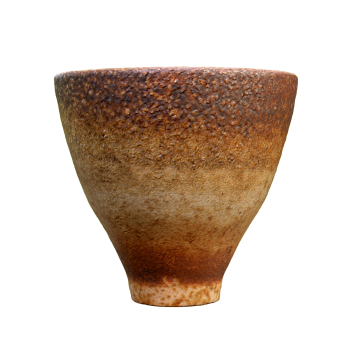
The stirrup shaped artifact is a colorful ceramic piece from the Bonn Collection in the Americas. The neck of the handle is slender, with a narrow opening, presenting an overall orange brown color tone. Partially drawn with white and red lines, there is a small bracket on the bottom side of the neck that may be used to hang objects. There are eight white and red structures shaped like cocoa beans around the main body of the object, each with a small horse stirrup at the top. On the body below the stirrup, there is a solid red circle surrounded by white and red circular borders. The origin of this artifact is unknown and belongs to the collection of Teddy Hahn.
Cosmic Starry Sky Ceramic Cup

Cosmic Starry Sky Ceramic Cup

A ceramic artwork meticulously created by the renowned Chinese master of arts and crafts, Peng Wangqiu. With its unique design and exquisite craftsmanship, it showcases the profound cultural heritage and artistic charm of Tongguan Kiln. Usually, it combines traditional and modern elements, cleverly combining Chinese classical aesthetics with modern aesthetic concepts to create ceramic artworks that have both traditional charm and modern aesthetics. Known for its exquisite glaze and unique starry sky pattern, it is not only a practical daily item, but also a collection full of artistic sense. Exquisite skills and unique artistic style have been highly praised and loved by collectors and art enthusiasts both domestically and internationally.
17th century Kyoto and its surrounding scenery
17th century Kyoto and its surrounding scenery

This artwork is called "Kyoto and its Surrounding Scenery" and was created in the early 17th century. It is now collected at the Minneapolis Museum of Art in the United States. The picture depicts many famous attractions in Kyoto. For example, at the top of the second and third panels on the right, you can see the famous Kiyomizu Temple with its long stairs and high balcony. A group of people gathered there, admiring the blooming cherry blossoms below. In the upper left corner of the screen, you can find the Kamigamo Shrine, where an annual horse racing event is being held nearby. You can see various large and brightly colored vehicles - these are the floats of the annual Gion Festival parade.
Mina'i porcelain bowl from Iran

Mina'i porcelain bowl from Iran

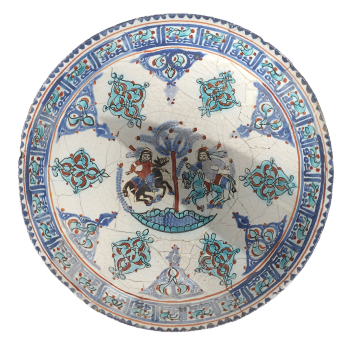
The Iranian Mina'i porcelain bowl you mentioned was made between 1200-1299 AD and is now collected at the Minneapolis Museum of Art in the United States. The theme of this porcelain bowl is two people riding horses on either side of a tree, which often appears on Mina'i porcelain and may imply a hunting scene, a luxury enjoyed by the prince class. The material of this porcelain bowl is gypsum, with glazed painted decorations on top.
The bowl depicting the 'female cavalry'
The bowl depicting the 'female cavalry'

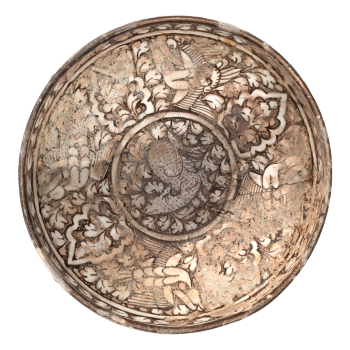
The bowl depicting a female knight "is an Iranian artwork from the 12th to 13th centuries, currently housed in the Minneapolis Museum of Art in the United States. This artwork is a bowl depicting a lady riding a horse. Mina'i ware is a type of pottery from the Seljuk period in Iran (1038-1194). This period may be the most creative era in Persian pottery production. In addition to gold-plated vessels, minai vessels, and monochrome blue glaze, underglaze painted pottery was also produced. These bowls represent a popular variation of black design painted under transparent turquoise colored glaze.
The bowl depicting the 'deer in the forest'

The bowl depicting the 'deer in the forest'

It is a 12th century pottery piece currently housed in the Minneapolis Museum of Art in the United States. This work is a bowl depicting the pattern of "deer in the forest". It is a part of Rayy Ware, a type of pottery from the Seljuk period in Iran (1038-1194). This period may be the most creative era in Persian pottery production. In addition to gold-plated vessels, minai vessels, and monochrome blue glaze, underglaze painted pottery was also produced. These bowls represent a popular variation of black design painted under transparent turquoise colored glaze.
Bowl with 'Willow Vine'

Bowl with 'Willow Vine'

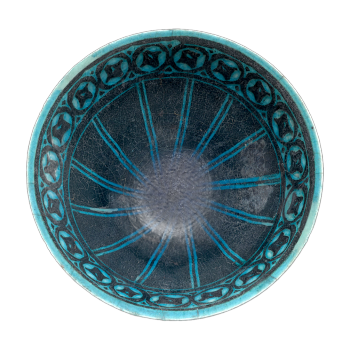
The blue glazed pottery bowl is a 12th century pottery item currently housed in the Minneapolis Museum of Art in the United States. This work is a bowl decorated with a "willow vine" pattern. It is a part of Rayy Ware, a type of pottery from the Seljuk period in Iran (1038-1194). This period may be the most creative era in Persian pottery production. In addition to gold-plated vessels, minai vessels, and monochrome blue glaze, underglaze painted pottery was also produced. These bowls represent a popular variation of black design painted under transparent turquoise colored glaze.
Green glazed pottery bowl

Green glazed pottery bowl

The blue glazed pottery bowl is a 12th century pottery item currently housed in the Minneapolis Museum of Art in the United States. This work is a bowl with a blue glaze. It is a part of Rayy Ware, a type of pottery from the Seljuk period in Iran (1038-1194). This period may be the most creative era in Persian pottery production. In addition to gold-plated vessels, minai vessels, and monochrome blue glaze, underglaze painted pottery was also produced. These bowls represent a popular variation of black design painted under transparent turquoise colored glaze.
The Bird in the Leaves

The Bird in the Leaves

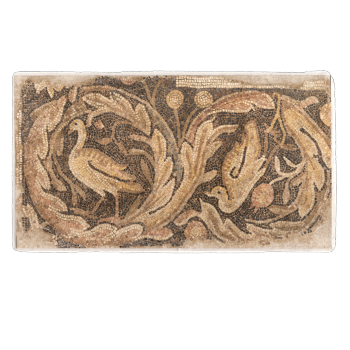
The Bird in the Leaf is a mosaic art from Türkiye, which is currently collected in the Minneapolis Museum of Art. The theme of this work is birds and plants, showcasing the Islamic art style of the 4th and 5th centuries.
Hercules and His Seventh Mission: Ceramic Plate

Hercules and His Seventh Mission: Ceramic Plate

It is a Majorica ceramic plate depicting the Greek mythological hero Hercules completing his seventh labor. Majorica is a ceramic art form originating from the Italian Renaissance period, known for its exquisite decoration and glaze colors. The central scene is presented in colorful tones, with Hercules' image located in the center of the disc, completing his seventh task of taming the raging bull on Crete. It showcases the power and courage of Hercules, as well as the exquisite craftsmanship of Majorica art. It is a representative of Italian Renaissance ceramic craftsmanship, with rich colors and vivid narrative scenes.
White jade pottery from the Warring States period

White jade pottery from the Warring States period

The head of the white jade gourd is intricately carved with phoenix cloud patterns, with traces of vermilion coating on it. The body of the gourd is intricately carved with cloud patterns, and the end is carved with a fish head with a round hole. The Warring States period (475 BC to 221 BC) was the golden age of jade craftsmanship. At that time, jade hairpins were mostly used for decorating hair buns and had exquisite carving and inlay techniques. These jade hairpins usually present patterns of moving plants and mythological legends.