Vienna Fifth District Vienna Goddess Fountain

Vienna Fifth District Vienna Goddess Fountain

This statue is the Vindobona statue of the Viennese goddess on the Siebenbrunen fountain in the Fifth District of Vienna. To commemorate the palace canal built in 1562 on the orders of King Ferdinand I, which supplied water to Hofburg in Vienna. Vindobona is the Latin name for Vienna during the Roman period. As part of the fountain, this statue not only beautifies the city landscape but also reflects Vienna's rich historical and cultural heritage.
Musashino Plain Six Curve Screen

Musashino Plain Six Curve Screen

It is one of the classic themes in Japanese art. In Japanese painting, there is a specific category called "Meisaku" that specifically depicts places famous for their poetry or literary stories. Musashino is such a place, mentioned in "Ise Monogatari" as a collection of lyrical stories from the 10th century. It usually consists of a pair and is colored with gold foil paper, showcasing the Japanese art style from the 17th to the 18th century. These screens are not only renowned for their beautiful natural landscapes, but also appreciated for their rich cultural and historical significance. It usually depicts Mount Fuji and the surrounding autumn grass, showcasing the peaceful beauty of autumn in Japan
Vienna Belvedere Palace Stone Vase

Vienna Belvedere Palace Stone Vase

This vase is a stone vase located in the garden of the Belvedere Palace in Vienna, featuring two busts and two masks. This decorative stone vase may reflect the artistic style of the Rococo period, during which artworks often contained rich decorative elements and sculptural details. The Belvedere Palace is one of Vienna's iconic buildings, showcasing Austria's rich cultural heritage and history through its gardens and decorative artworks.
John Adam Moser Clan Emblem Seal

John Adam Moser Clan Emblem Seal

John Adam Moser was an 18th century German jurist, administrative official, and writer who had a profound understanding and contribution to the legal and administrative system of his time. This seal not only serves as proof of personal identity, but also reflects the level of seal art and craftsmanship at that time. The handle is engraved with the words "1751" to indicate the year of production.
Seal of the 17th Century Craftsmen's Guild

Seal of the 17th Century Craftsmen's Guild

This seal is the seal of the blacksmith and armored craftsman, as well as the wheel manufacturing and car making guild of Pugao, which dates back to the 17th to 18th centuries. The seal represents the guilds of blacksmiths and armors (Huf - und Waffenshmiede) and wheel makers and wheelmakers (Rad - und Stellmacher) in Pugao.
Seal of the abbot of Schlierbach Monastery

Seal of the abbot of Schlierbach Monastery

This seal is part of the history of the Schlierbach Monastery, and its design and decoration reflect the religious art and badge studies of the late 17th century. The emblem and dean's emblem on the seal indicate the religious status of the monastery and the authority of the dean. The Baroque style decoration added artistic beauty and also reflected the popular art style at that time.
Baron von Schreck's silver seal

Baron von Schreck's silver seal

This seal is the family emblem of Baron von Schreck, usually featuring elements such as unicorns and lions representing the nobility and power of the noble family, while the knowledge tree may symbolize the wisdom or knowledge inheritance of the family. The helmet with a crown is a symbol of aristocratic status, while the intricate decorative patterns showcase artistic and craftsmanship.
Seal of the Society of Kellenberger Seymandel

Seal of the Society of Kellenberger Seymandel

The design of this postal seal reflects a certain social phenomenon or sense of humor in 19th century Austria, expressing a joke about a certain social role or family relationship by placing characters in cages. Simandel is an Austrian proverb used humorously to refer to a spouse who is obedient to the mistress of the household.
Vienna Monument to the Liberation of Soviet Soldiers

Vienna Monument to the Liberation of Soviet Soldiers

The statue of a Soviet soldier at the entrance of the Vienna Monument to the Liberation of Soviet Soldiers. The statue is located at the entrance of the Vienna Soviet Soldiers' Liberation Monument, where these soldiers sacrificed their lives during the liberation of Vienna. A Rotamist, a lower rank soldier in the Soviet Red Army, is depicted holding a lowered flag and weapon. Sculptor Ivan Perschudtschew designed this statue. The cemetery complex covers an area of 3600 square meters and is the final resting place for nearly 2500 Red Army soldiers.
Slavin War Memorial

Slavin War Memorial

The Slavin War Memorial is an important landmark in Bratislava, which not only commemorates the Soviet soldiers who sacrificed their lives in the war, but also witnesses to historical events. The design and architecture of this memorial site reflect the respect for war heroes and the desire for peace at that time. The statues of two soldiers and children as part of the memorial site symbolize the sacrifices of soldiers, the brutality of war, and hope for future peace. Such statues are common in war memorials, aimed at conveying condolences for lost lives and educational significance for future generations.
Baroque style slave statue

Baroque style slave statue

The Baroque style slave statue on the tomb wall in front of the Heiligenkreis Monastery. The creation time was around 1731. Giovanni Giuliani, a sculptor working for the Heiligenkreis Monastery at the time. The depiction of slaves may be related to the second Türkiye siege in 1683, which was not too long ago at that time. Celebrate the victory over aggressors by depicting scenes of suffering and conquered slaves.
Friedrich Schiller Memorial

Friedrich Schiller Memorial

This bronze statue is the Friedrich Schiller Memorial on Schiller Square in Vienna's First District. There are four seated figures at the four corners of the pedestal, derived from Schiller's poem "The Song of the Bell", representing children (sitting on their mother's lap), the elderly, young travelers, and cast iron workers. Franz P ö nninger and Josef R ö lich created this monument at the K.K. Art Foundry.
Japanese gold vase

Japanese gold vase

It is a representative of traditional Japanese craftsmanship, which involves re bonding broken ceramic fragments with gold powder or paint to give them new life and beauty. The term 'jinzao' comes from the Japanese word 'jin 継ぎ', meaning 'repair with gold'. This technique is not just about restoration, but also an art form that views fragmentation as a part of life, connecting fragments with gold threads to showcase a unique aesthetic. High quality ceramic materials are usually selected, carefully designed and made, then intentionally broken and repaired. The aesthetic concept of gold vase corresponds to the Japanese culture of "wabi sabi", which appreciates the beauty of imperfection, impermanence, and incompleteness.
18th Century Gilded Gold and Silver Medal Commemorative Medal

18th Century Gilded Gold and Silver Medal Commemorative Medal

The inscription on this 18th century medal expresses good wishes for love and marriage, and the design of the visual puzzle adds artistic and entertaining elements. The material and exquisite craftsmanship of gilded gold and silver indicate that this is a customized souvenir for special occasions or important figures. At that time, such medals were given as gifts to show respect or celebrate. It is currently housed in the Heiligenkreis Monastery Museum.
Moses sculpture in the fountain of Vienna's first district

Moses sculpture in the fountain of Vienna's first district

The statue of Moses on the fountain named after him in the first district of Vienna was created by sculptor John Martin Fischer. Johann Martin Fischer was an 18th century Austrian sculptor known for his neoclassical style and significant contributions to urban sculpture in Vienna. The Moses Fountain is a historical landmark in Vienna, whose design and decoration reflect the artistic style and cultural values of the time.
Statue of Black Boy Actor

Statue of Black Boy Actor

A standing black boy statue created by Giovanni Giuliani, with the boy holding a performance prop bowl in his left hand. This is not only used for decoration. Fruits or candies are placed on display bowls or used as support for multi armed candlesticks. This statue can be found at the Heiligenkreis Monastery Museum.
Karl Liebertner Memorial Medal

Karl Liebertner Memorial Medal

Karl Liebertner is a figure who has made significant contributions in the fields of music or art, and the design of this medal reflects his achievements and influence. The inscription and pattern on the back indicate a close connection between Liebleitner and children's music, as he was a composer, music educator, or figure related to children's music activities. Laurel leaves usually symbolize victory and honor, while vines and rose bushes add artistic and decorative elements.
Japanese mythology legend: The Great Tengu Mask

Japanese mythology legend: The Great Tengu Mask

It is a traditional Japanese mask art with distinct cultural characteristics and profound historical background. Da Tian Gou is a creature in Japanese mythology, often depicted as a mysterious being with a long nose, a red face, and wings. In folklore, Tengu is the guardian of the mountains and forests, possessing supernatural powers. Sometimes it is considered a mischievous elf, while other times it is seen as a symbol of wisdom and power. The design is usually very exaggerated, with a long and curved nose being its most prominent feature, representing the arrogance and conceit of Tengu. Symbolizing the reverence for nature and supernatural forces in Japanese culture. It has also become one of the symbols of Japanese culture.
Chinese Loong Sculpture in Tianhou Palace

Chinese Loong Sculpture in Tianhou Palace

Tianhou Temple is located in Shekou District, Shenzhen, Guangdong Province, China. It is a long-standing Taoist temple that enshrines the sea goddess Mazu. In the courtyard, there is a striking dragon sculpture. This dragon is presented in the image of a traditional Chinese Loong, beautifully carved and rich in details. The dragon's body winds and spirals, its scales are clearly visible, and its claws are strong and powerful, showcasing the majesty and mystery of the dragon. The dragon's head lifted high, its eyes shining brightly, as if guarding this temple and the people who came to worship. Not only is it a display of art, but it also contains profound cultural significance. In traditional Chinese culture, the dragon is a symbol of auspiciousness, representing strength, wisdom, and good luck.
Saint Paulino

Saint Paulino

St. Paul of Thebes, located on the bitter road of the Heiligenkreis Monastery. Statue making began in 1731. Saint Paulino is a saint in Christianity. According to legend, he was the first hermit of Egypt and the father of the desert, hence also known as the hermit of Saint Paulino I. The story of Saint Paulino holds an important position in the Christian tradition, as he is considered a model of reclusive life, symbolizing extreme devotion to religious beliefs and a life of seclusion and practice. On the arduous path of the Heiligenkreis Monastery, the statue of Saint Paulino stands alongside other statues.
Saint Neopomuk

Saint Neopomuk

This is the statue of Saint Nepomuk in Weitesfeld. The statue of Saint Neopomuk stands on a pedestal decorated with a small angel's head, holding a cross and an angel. The construction of the statue can be traced back to 1710. Saint Neopomuk is a saint in the Catholic Church, known for his role as the patron saint of Bohemia and the guardian of bridges. He is usually depicted standing or crossing a bridge, holding a cross and palm branches. The creation period of the statue of Saint Neopomuk coincided with the rise of Baroque art, and works of art during this period often emphasized emotional expression and dynamic forms.
Statue of Judah

Statue of Judah

The statue of Judas located in front of the Church of Our Lady in Kleinschwanstein Bart. The statue was made in the first half of the 18th century. The Apostle Judas is one of the twelve apostles of Jesus Christ, often mentioned together with Saint Simon as the "Passionate Judas". In Christian tradition, he is known for his steadfast faith and preaching of the gospel. The image of Judas apostles in Christianity is often associated with loyalty and a spirit of sacrifice. In some works of art, he is often depicted as holding a letter, as he is rumored to be the author of the Book of Judas in the New Testament, which emphasizes the adherence to the Christian faith and the fight against heresy.
Geza Giaoni

Geza Giaoni

Geza Giaoni was a Hungarian poet who wrote for the literary magazine Nyugat in Budapest and began a long-term literary competition with the leading Hungarian poet at the time, Ndele Adi. In his second poetry collection "Sad Eyes" published in 1909, he criticized Adi. In November 1907, Gioni was conscripted into the Austro Hungarian army, and in 1912, he was called up to actively serve in the Balkan Wars. As a response to the war, Giovanni wrote the pacifist poem "Caesar, I Don't Leave" and died in a Russian prisoner of war camp during World War I.
Anton Menger

Anton Menger

Anton Menger's tomb, as well as the Vienna Central Cemetery. Anton Menger (1841-1906) was a jurist and social theorist. Menger's paper was proposed in the context of the constantly changing social order since the mid-19th century, marked by the economic crisis and social issues of 1873, seeking answers to liberal policies and striving for more social justice. Richard Coffin designed this tombstone. The tomb of Anton Menger is not only a commemoration of this jurist and philosopher, but also a symbol of social change and political thought development in the late 19th century.
Chinese white glazed porcelain vase with colored cracks

Chinese white glazed porcelain vase with colored cracks

It is a molded porcelain drum shaped Chinese porcelain vase with white glaze and colored cracks. The production period is from 1950 to 1960. White glaze and cracked glaze effects are common techniques in porcelain production. White glaze provides a smooth and reflective surface, while cracked glaze is a special decorative technique that creates unique textures and patterns by introducing tiny cracks into the glaze. Not only is it beautiful, but over time, porcelain with cracked glaze will gradually develop its own unique appearance. It is part of the William M. Lindgren Asian Art Collection, preserved in the archives of St. Cloud State University.
Glass enamel decorated Chinese cloisonn é vase

Glass enamel decorated Chinese cloisonn é vase

It is a Chinese cloisonn é vase decorated with glass enamel, belonging to the William M. Lindgren Asian Art Collection and currently housed in the archives of St. Cloud State University. The period is approximately between 1930 and 1950. Cloisonn é craftsmanship is an ancient Chinese metal craft known for its exquisite copper body, enamel glaze, and complex production process. This process usually involves welding fine copper wires onto a copper body to form patterns, then filling these patterns with enamel glaze. After multiple firing and polishing processes, the final product is a colorful and glossy artwork. It is one of China's intangible cultural heritages.
Maya Culture Ceramic Wine Cup - Metropolitan Museum of Art

Maya Culture Ceramic Wine Cup - Metropolitan Museum of Art

This cylindrical drinking cup, which is a Maya cultural artwork collected by the Metropolitan Museum of Art, is considered a representative work of the Maya pottery painter "Metropolitan Master". It features a mythological scene depicting the young rain god Chahk and a supernatural young leopard. Chahk appears in its typical attire and symbolic accessories, while juvenile jaguars are presented with their supernatural facial features and body details. Not only does it showcase the exquisite craftsmanship of Maya art, but it also reflects the complex myths about life, death, and rebirth in Maya culture. Provided important clues for researchers on Maya religion and ritual practices
Clay Vase - Krakow Archaeological Museum, Poland

Clay Vase - Krakow Archaeological Museum, Poland

The Archaeological Museum in Krakow, Poland, has a collection of pottery fragments dating back to ancient times. These fragments were discovered during salvage excavations at the 1c site in Mogila (the area where the S. Ż eromski Hospital is located) in 1958. After repair, this pottery was able to be restored. It is made of sieved good soil on a ceramic wheel, with a smooth surface and polished. Above the crease on the shoulder, a decoration can be seen, limited by decorative strips, presented in a zigzag and diagonal mesh shape, separated by three buttons. This decoration is similar to the common decoration in the Przewalski culture and also appears on the edge of this container.
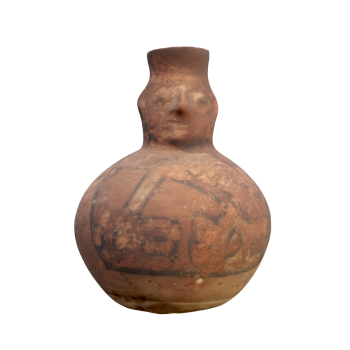
Dog shaped ceramic container

Dog shaped ceramic container

From the central coast of present-day Peru. It represents a dog breed called "viringo", which is the Peruvian Hairless Dog. In ancient American culture, it was valued for its unique appearance and characteristics, and was included in funeral ceremonies, as well as depicted on painted pottery. Nowadays, it has become an important symbol of Peruvian culture. It showcases the ancient Peruvian people's worship and artistic expression of animals, reflecting their profound understanding and respect for nature and animals. Be able to understand the lifestyle, religious beliefs, and artistic aesthetics of ancient Peruvian society. It is one of the important physical evidence for studying ancient Peruvian civilization.
Chancay culture monkey shaped pottery container

Chancay culture monkey shaped pottery container

It is a ceramic artwork in the Chancay culture, created around 1300 to 1500 by an unknown Peruvian artist. Usually used for storing water, which is crucial for survival in the dry desert climate where one resides. The Chancay culture is located in the central coastal region of Peru, where the climate is hot and dry, but there are some oases connected to distant areas of the Andes mountain range, allowing for communication with other cultures and communities, trading plants, food, and other agricultural products. On both sides of the neck are a pair of monkeys, both covering their mouths with their hands. The monkey's tail curves upwards and connects to the neck of the container.
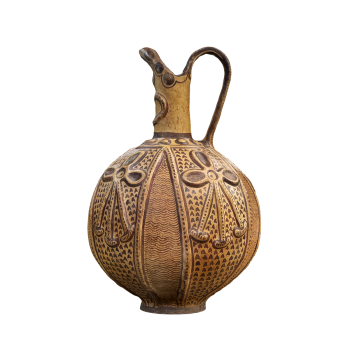
Ancient snake shaped ceramic container

Ancient snake shaped ceramic container

Mercury Bronze Statue - Depuras Archaeological Museum

Mercury Bronze Statue - Depuras Archaeological Museum

The bronze statue of Mercury is a messenger of the gods in Roman mythology, as well as a god of livestock, thieves, commerce, transportation, tourism, and sports. It is one of the twelve main gods of Rome. Corresponding to Hermes in Greek mythology. He was Jupiter's most loyal messenger, delivering messages to Jupiter and completing various tasks entrusted to him by Jupiter. He is agile, energetic, and versatile. Usually a middle-aged man wearing a hat with wings, flying shoes, holding a wand, and walking like flying. It is currently housed in the De Plath Archaeological Museum.
Ancient Chinese Bronze Tripod - Minneapolis Museum of Art

Ancient Chinese Bronze Tripod - Minneapolis Museum of Art

Ding is a bronze container used for cooking and worship in ancient China, with a history dating back to the 11th century BC to the 10th century BC. The characteristic is a flat bottom, three legged support, and high artistic and historical value. During the Shang Dynasty, the legs of bronze tripods were mostly flat, usually designed in the shape of dragons. In the early Western Zhou Dynasty, tripod legs began to be popular in the form of birds. The tripod collected by the Minneapolis Museum of Art features a bird shaped design with three legs, standing on claws and tail, and decorated with cicada patterns above the legs. It reflects the bronze casting technology of ancient China, as well as the aesthetic and cultural beliefs of the society at that time.
Qing Dynasty Ding Kiln Incense Burner - Krakow National Museum

Qing Dynasty Ding Kiln Incense Burner - Krakow National Museum

Known for its exquisite craftsmanship and unique design, especially the incense burner with hollowed out carved lids and dragon shaped handles. Not only is it a practical fragrance tool, but it is also an exquisite artwork. A Ding kiln incense burner collected in the Krakow National Museum features a translucent carving technique on its lid, adorned with exquisite patterns, and a dragon shaped handle, reflecting the nobility and power of the dragon in traditional Chinese culture. Made between 1736 and 1795, it showcases the superb craftsmanship of Qing Dynasty porcelain production. It is a witness to the exchange of Chinese and Western cultures, and an outstanding representative of traditional Chinese crafts.
Hangzhou Great Wall Relief

Hangzhou Great Wall Relief

Great Wall relief is an art form that uses copper as the material and condenses the magnificent scenery and historical culture of the Great Wall into exquisite relief works through forging, carving, and other techniques. In Hangzhou, such works of art not only showcase the historical and cultural value of the Great Wall, but also reflect the outstanding achievements of ancient Chinese military wisdom and architectural technology. These relief works embody the wisdom and courage of the Chinese nation, becoming a symbol of national spirit and a treasure of ancient Chinese civilization. As a form of artistic expression, it allows people to appreciate art while gaining a deeper understanding and appreciation of the history and culture of the Great Wall.